Bitbucket vs RhodeCode: Which Source Code Management Platform Fits Enterprise Teams?
Compare Bitbucket vs RhodeCode for enterprise SCM, self-hosting, security, pricing and Git management. Explore self-hosted Bitbucket alternatives.
Choosing a source code management platform is not just about where developers push code. It determines how an organization protects intellectual property, manages access across teams, integrates development tools, and maintains control over critical engineering infrastructure.
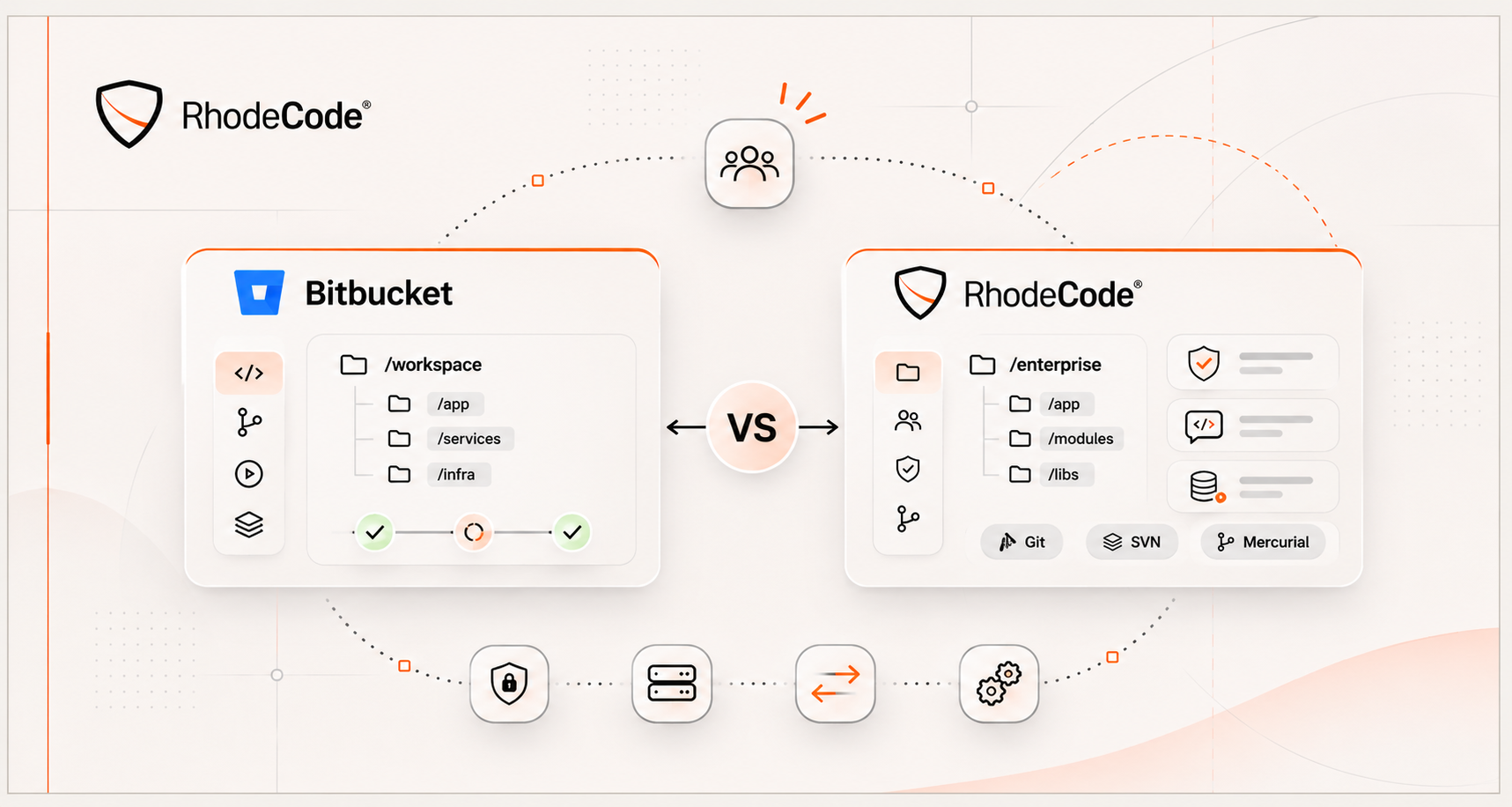
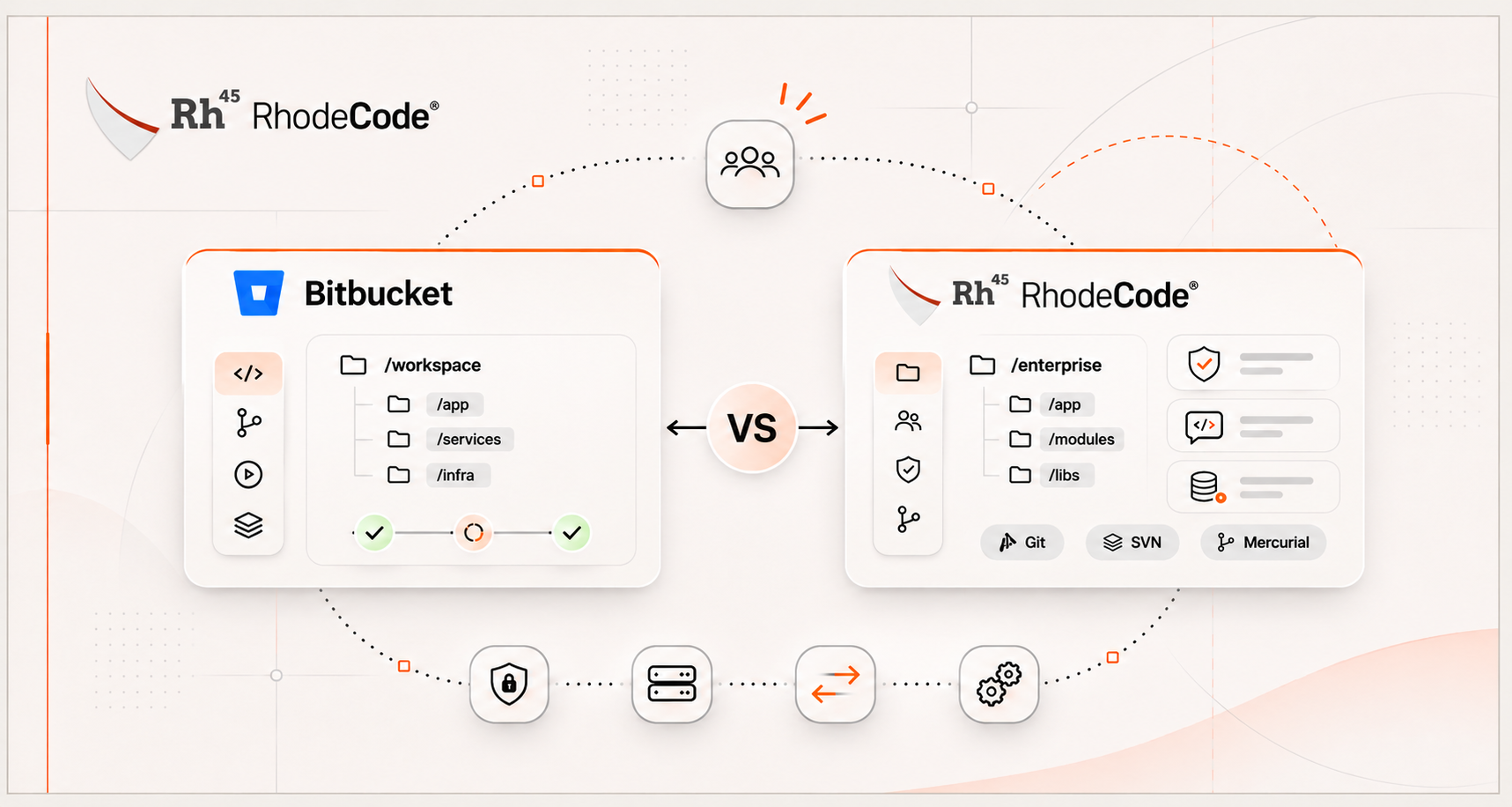
Bitbucket is an established Git platform with strong integrations across the Atlassian ecosystem. RhodeCode takes a different approach, combining self-hosted source code management, centralized governance, and native support for Git, Mercurial, and Subversion.
For enterprises evaluating Bitbucket alternatives, the decision becomes particularly relevant when infrastructure independence, licensing flexibility, security requirements, and multiple version control systems influence long-term strategy.
This Bitbucket vs RhodeCode comparison examines both platforms from an enterprise perspective, covering deployment, security, collaboration, scalability, pricing, and migration requirements.
TL;DR
- Bitbucket Cloud suits Git-based teams prioritizing managed infrastructure, Jira integration, and built-in CI/CD.
- Bitbucket Data Center supports self-managed Git environments and will continue beyond 2029 through the Bitbucket Hybrid License.
- RhodeCode provides centralized management of Git, Mercurial, and SVN repositories within one platform.
- RhodeCode Community Edition offers free, open-source SCM with unlimited users and repositories.
- RhodeCode Enterprise is particularly relevant for organizations requiring infrastructure independence, advanced permissions, enterprise authentication, and high availability.
Bitbucket vs RhodeCode: Key Differences
Both platforms support private Git repositories, code review, permissions, and enterprise development workflows. Their main differences concern deployment models, version control coverage, licensing, and integration architecture.
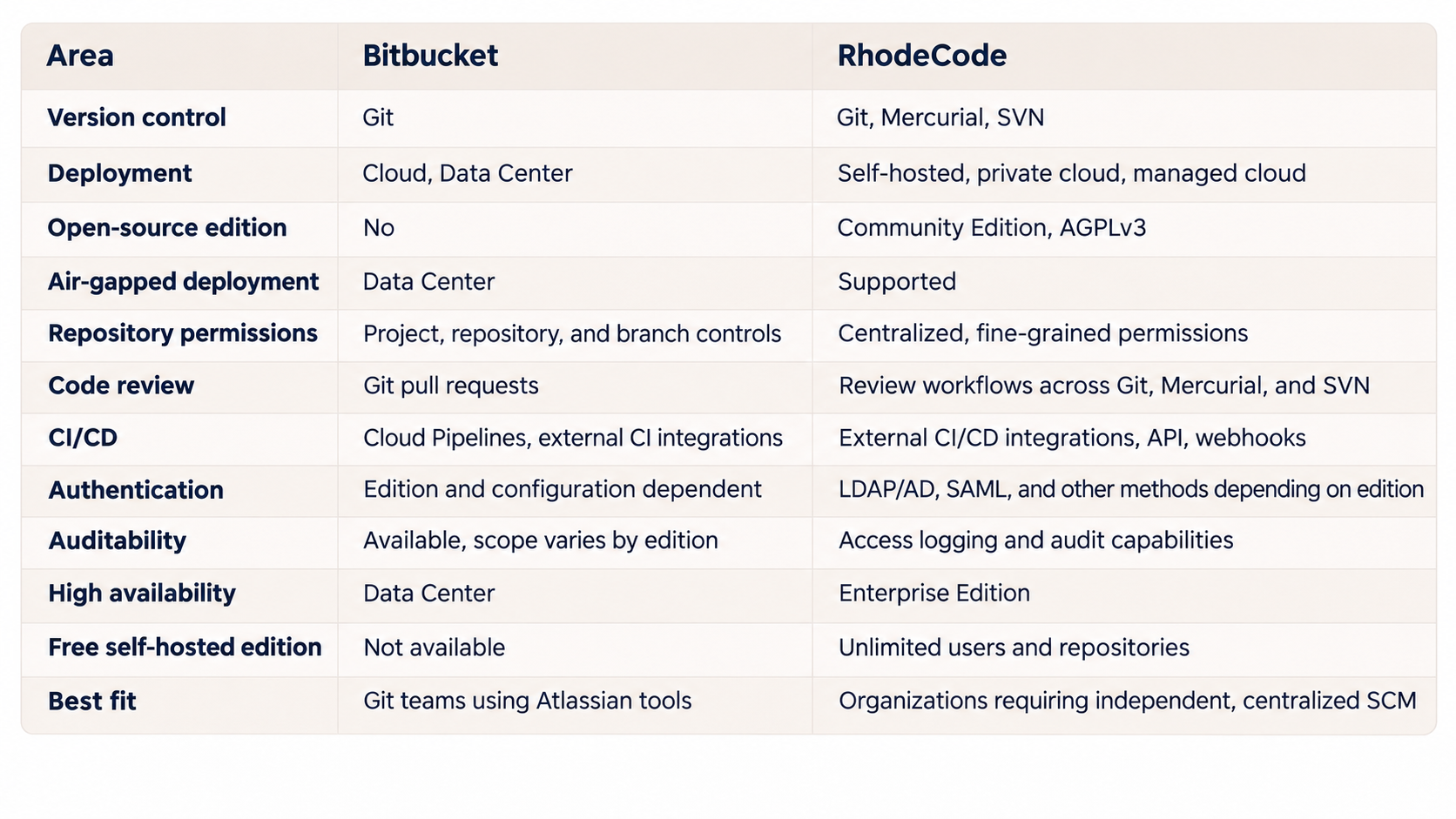
Capabilities depend on product version, subscription, deployment architecture, and configuration.
Bitbucket delivers particular value within the Atlassian ecosystem. RhodeCode focuses on repository management and governance without requiring organizations to adopt a specific issue-tracking or CI/CD platform.
Bitbucket Cloud vs Bitbucket Server vs Data Center
Understanding Bitbucket's deployment options is essential before evaluating alternatives. These products have different infrastructure responsibilities, licensing conditions, and long-term availability.
Bitbucket Cloud
Bitbucket Cloud is Atlassian's managed Git hosting service. Organizations use repositories, pull requests, Jira integrations, and Bitbucket Pipelines without maintaining the underlying SCM infrastructure.
This approach reduces operational overhead and works well for cloud-oriented engineering teams. Organizations with strict network isolation or infrastructure ownership requirements may prefer a self-managed deployment.
Bitbucket Server and Data Center
Bitbucket Server reached end of support on February 15, 2024. Bitbucket Data Center remains Atlassian's supported self-managed Git platform, offering deployment options for enterprise availability and scalability.
Organizations searching for an on-premises Bitbucket solution should distinguish between the discontinued Server product and Data Center. They should also evaluate the licensing changes affecting future self-managed deployments.
What Is the Bitbucket Hybrid License?
Atlassian has confirmed that Bitbucket Data Center will continue beyond March 28, 2029, unlike several other Data Center products.
Under the Bitbucket Hybrid License, eligible existing customers can retain self-managed Bitbucket environments while gaining access to Bitbucket Cloud capabilities.
Existing Data Center licenses remain available until March 28, 2029, after which Bitbucket Data Center will be offered exclusively through the hybrid licensing model. Organizations should confirm eligibility and commercial terms directly with Atlassian.
For enterprises evaluating Bitbucket Data Center alternatives, this is not necessarily a reason to migrate immediately. It is an opportunity to assess whether future licensing and platform dependencies align with their infrastructure strategy.
Self-Hosting and Infrastructure Independence
Self-hosting remains a critical requirement for organizations handling proprietary software, sensitive infrastructure configurations, regulated data, and business-critical source code.
Both Bitbucket Data Center and RhodeCode support self-managed deployment. Differences emerge when organizations evaluate licensing flexibility, infrastructure ownership, and dependence on a wider software ecosystem.
Bitbucket Self-Hosted Deployment
Bitbucket Data Center allows enterprises to operate Git repositories within their own infrastructure. Organizations can configure network restrictions, database architecture, storage, and application availability according to their requirements.
This deployment model is particularly attractive to companies already using Jira, Bamboo, and other Atlassian products. However, licensing eligibility and future subscription conditions should form part of any long-term infrastructure evaluation.
RhodeCode Self-Hosted Source Code Management
RhodeCode supports deployment on organization-owned servers, private cloud infrastructure, and fully air-gapped environments.
Organizations retain control over repository storage, network boundaries, deployment architecture, and data residency. RhodeCode Community Edition also provides an open-source deployment option without per-user licensing fees.
For teams seeking a self-hosted Bitbucket alternative, this flexibility allows SCM infrastructure to remain independent of broader cloud adoption decisions.
Enterprise Version Control: Git, Mercurial, and SVN
Version control coverage is one of the most significant differences between Bitbucket and RhodeCode. While Bitbucket focuses on Git, RhodeCode supports three major version control systems natively.
Managing Mixed Repository Environments
Git dominates modern software development, but many enterprises still maintain Mercurial and SVN repositories. Long-lived industrial applications, embedded software, financial systems, and acquired products may depend on established version control workflows.
Moving every repository to Git can require substantial engineering effort, integration changes, and validation. Migration may also introduce unnecessary risk when existing systems remain stable and business-critical.
RhodeCode allows teams to manage Git, Mercurial, and SVN within one SCM environment. Administrators can organize repositories, manage access, and support collaboration without requiring immediate VCS standardization.
Organizations modernizing their infrastructure can therefore separate repository governance improvements from version control migration decisions.
For a broader evaluation of enterprise requirements, see What to Look for in Enterprise Source Code Management Software.
Security, Git Repository Permissions, and Compliance
Enterprise Git repository security requires more than private repositories. Organizations need consistent access policies, identity management, protected branches, and evidence of repository activity.
Bitbucket and RhodeCode provide security controls, but their implementation and administrative models differ. Evaluation should focus on actual policy requirements rather than general security claims.
Authentication and Access Control
Bitbucket supports project and repository permissions, branch restrictions, and authentication options that vary by deployment and subscription.
RhodeCode provides centralized user and group management, granular repository permissions, and subject-specific IP restrictions. Enterprise authentication options include SAML-based SSO, alongside LDAP and Active Directory integration capabilities.
These controls help administrators manage access across departments, projects, contractors, and automated services. Organizations can reduce reliance on individually maintained permissions as repository environments grow.
Explore RhodeCode Permissions and Security for details about access control, authentication, and audit capabilities.
Branch Protection and Approval Policies
Both platforms allow teams to restrict modifications to critical branches and enforce review requirements. Bitbucket supports merge checks, with certain enforcement capabilities depending on edition or subscription.
RhodeCode Enterprise provides advanced branch protection, force-push restrictions, reviewer rules, and required approvals. Reviewer policies can identify responsible teams based on the paths affected by a change.
This is particularly useful when repositories contain components owned by different engineering teams or when sensitive changes require specialized approval.
Audit Logs and Compliance Evidence
Git commit history explains what changed in source code, but it does not provide complete visibility into repository administration and access activity.
Bitbucket offers auditing capabilities that depend on the selected product and configuration. RhodeCode provides audit and access logging, including options to export evidence or connect logging with external security monitoring systems.
Neither platform automatically guarantees regulatory compliance. Organizations must configure controls, preserve relevant evidence, and validate their processes against applicable requirements.
Our Git Repository Security Best Practices for Enterprise Teams guide covers these controls in greater detail.
Code Review, CI/CD, and Team Collaboration
Code review and automation influence how quickly engineering teams deliver changes without compromising quality. Selecting enterprise code review tools therefore requires examining how repositories interact with the wider development environment.
Bitbucket and the Atlassian Ecosystem
Bitbucket integrates closely with Jira, connecting repository activity and pull requests with issue-tracking workflows. Bitbucket Cloud also includes Bitbucket Pipelines, which supports automated builds, tests, and deployments.
This combination makes Bitbucket attractive to teams seeking an integrated development experience within Atlassian products. Data Center environments can integrate with external CI systems such as Bamboo and Jenkins.
RhodeCode and Existing Development Infrastructure
RhodeCode provides pull requests, inline comments, review history, and repository-level collaboration across supported version control systems.
Enterprise reviewer rules help assign relevant reviewers and enforce approval requirements. Built-in integrations, REST APIs, webhooks, and server-side hooks connect SCM workflows with existing engineering tools.
Rather than replacing CI/CD infrastructure, RhodeCode allows organizations to retain Jenkins, Bamboo, Jira, and other established systems. This can reduce migration complexity for enterprises with mature development pipelines.
Explore RhodeCode Code Review and Integrations to evaluate how existing workflows can be supported.
Enterprise Scalability and High Availability
Operating an enterprise Git server involves more than supporting large numbers of repositories. Performance depends on repository size, concurrent developers, automated Git operations, database workloads, code search, and storage architecture.
Bitbucket Data Center and RhodeCode Enterprise both address scenarios where SCM availability becomes business-critical.
Bitbucket Data Center supports clustered deployment, subject to infrastructure and configuration requirements. RhodeCode Enterprise provides multi-node scaling, high-availability configurations, and cross-repository code search.
For organizations evaluating a self-hosted Git server, realistic workload testing remains essential. Neither platform can guarantee performance or recovery targets independently of its deployment architecture.
Recovery planning must also extend beyond repository replication. Our guide to Git Repository Backup vs Mirroring explains how backups, replication, and disaster recovery protect enterprise SCM operations.
Bitbucket vs RhodeCode: Pricing and Total Cost of Ownership
Licensing differences can significantly affect enterprise source code management costs. Organizations must consider subscription fees alongside infrastructure, administration, integrations, maintenance, and migration expenses.
Bitbucket Licensing
Bitbucket Cloud uses subscription-based pricing, with costs and capabilities determined by the selected plan.
Bitbucket Data Center follows commercial licensing arrangements, while eligible customers can transition to the Bitbucket Hybrid License. Enterprises should obtain current pricing and confirm renewal conditions before making long-term commitments.
RhodeCode Community vs Enterprise
RhodeCode separates its open-source foundation from commercial enterprise capabilities. This allows organizations to evaluate core SCM functionality without immediately committing to a paid deployment.
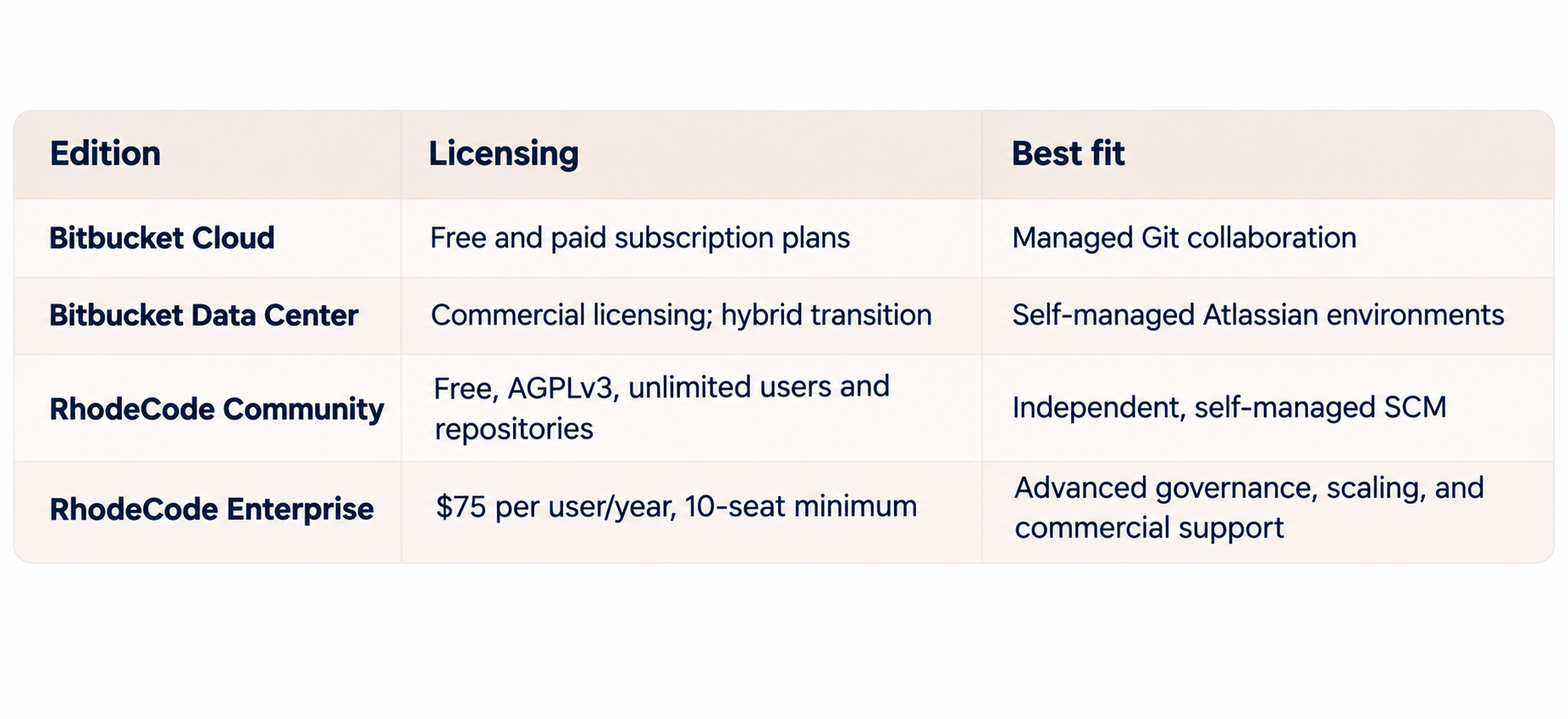
RhodeCode pricing reflects published rates as of November 2026. Confirm current licensing conditions before purchasing.
RhodeCode Enterprise includes capabilities such as advanced authentication, reviewer rules, technical support, high availability, and scalable code search.
Organizations looking for an open-source Bitbucket alternative can start with Community Edition and evaluate Enterprise functionality as operational requirements grow. See RhodeCode Pricing for current edition details.
Migrating from Bitbucket to RhodeCode
Migrating repositories involves more than transferring Git commits. Enterprise teams must preserve development workflows, security policies, integration behavior, and operational continuity.
Git history can generally be transferred using standard repository migration mechanisms. Platform-specific data, including pull requests, comments, permissions, and integration settings, requires separate assessment.
Enterprise Migration Checklist
- Inventory repositories and dependencies. Identify Git repositories, access policies, integrations, Git LFS objects, and critical development workflows.
- Map permissions and identities. Recreate repository groups, user access, authentication settings, and branch protection requirements.
- Validate data migration. Transfer repositories and determine how historical review metadata and other platform-specific information will be preserved.
- Reconnect development tools. Configure CI/CD integrations, issue trackers, webhooks, credentials, and automated workflows.
- Test before production cutover. Validate repository integrity, access restrictions, review policies, performance, backup procedures, and rollback readiness.
Organizations should begin with representative repositories before migrating business-critical projects. This helps identify compatibility gaps and operational risks without disrupting the entire engineering environment.
Which Source Code Management Platform Should Enterprise Teams Choose?
Platform selection should reflect infrastructure requirements, existing tools, version control systems, and long-term business priorities.
Choose Bitbucket Cloud when development teams use Git, prioritize managed infrastructure, and benefit from built-in Pipelines and close Jira integration.
Choose Bitbucket Data Center when organizations already depend on the Atlassian ecosystem, require self-managed Git hosting, and find the future hybrid licensing model suitable.
Choose RhodeCode when enterprises need infrastructure independence, centralized repository governance, flexible licensing, advanced access controls, and support for multiple version control systems.
RhodeCode is especially relevant when organizations want to improve enterprise Git repository management without replacing established CI/CD tools or migrating every legacy repository.
Teams comparing additional self-hosted platforms can also explore our Gitea vs Forgejo vs RhodeCode comparison.
Why RhodeCode Is Worth Evaluating as a Bitbucket Alternative
RhodeCode combines enterprise version control, repository security, collaboration, and administration within infrastructure that organizations can control.
Its strongest advantages emerge when source code governance extends beyond Git hosting: multiple VCS technologies, sensitive repositories, complex permissions, established CI/CD infrastructure, and long-term deployment independence.
Organizations do not need to replace their entire development environment to improve source code management. RhodeCode allows teams to evaluate SCM as an independent infrastructure component.
Explore RhodeCode Enterprise to compare deployment and governance capabilities, or try RhodeCode to evaluate the platform against your own repositories and development workflows.
FAQ
What is the main difference between Bitbucket and RhodeCode?
Bitbucket focuses on Git hosting and integration with Atlassian development tools. RhodeCode provides centralized source code management for Git, Mercurial, and SVN, with self-hosted deployment, granular permissions, and enterprise governance capabilities.
Is RhodeCode a good alternative to Bitbucket?
RhodeCode is particularly suitable for organizations requiring independent self-hosting, multiple version control systems, centralized repository management, and enterprise security controls. Bitbucket may remain preferable for Git-only teams heavily invested in the Atlassian ecosystem.
Is there an open-source alternative to Bitbucket?
RhodeCode Community Edition provides an open-source SCM platform under AGPLv3, supporting unlimited users and repositories. Organizations can upgrade to Enterprise Edition when they require additional governance, authentication, scalability, or commercial support.
Is Bitbucket Data Center being discontinued in 2029?
No. Atlassian has confirmed that Bitbucket Data Center will continue beyond March 28, 2029, through the Bitbucket Hybrid License. Existing customers should verify eligibility, renewal conditions, and commercial terms directly with Atlassian.
Can RhodeCode replace Bitbucket in an enterprise environment?
Yes, provided RhodeCode meets the organization's functional and operational requirements. Enterprises should evaluate repository permissions, code review, integrations, migration of historical metadata, availability, and security policies before replacing an existing Bitbucket deployment.
Does RhodeCode integrate with Jira and Jenkins?
Yes. RhodeCode supports integrations with Jira, Jenkins, and other development tools. REST APIs, webhooks, and server-side hooks also allow organizations to connect custom automation and existing CI/CD infrastructure.
Which platform is better for mixed version control environments?
RhodeCode has an architectural advantage when organizations maintain Git, Mercurial, and SVN repositories. Its native support for all three allows teams to centralize management without immediately migrating legacy repositories to Git.