Gitea vs Forgejo vs RhodeCode: Which Self-Hosted Git Platform Is Best for Enterprise Teams?
Compare Gitea vs Forgejo vs RhodeCode for enterprise Git hosting, security, code review, scalability, and source code management.
Choosing a self-hosted Git platform becomes more complicated when repositories span multiple teams, security policies, and legacy systems. Git hosting alone is no longer enough. Organizations need reliable access control, code review, auditability, and scalable repository management.
Gitea and Forgejo offer lightweight Git hosting with collaboration and automation tools. RhodeCode focuses on enterprise source code management across Git, Mercurial, and SVN.
This Gitea vs Forgejo vs RhodeCode comparison examines their differences in security, CI/CD, scalability, and enterprise governance to help teams choose the right platform.
TL;DR
- Gitea fits Git-only teams seeking lightweight self-hosted hosting, collaboration, and integrated automation.
- Forgejo suits organizations prioritizing community-governed open-source software and independent development.
- RhodeCode fits enterprises needing centralized repository governance, advanced permissions, and Git, Mercurial, and SVN support.
- All three provide code review and access controls, but capabilities differ by version and edition.
- Best choice depends on security requirements, existing infrastructure, repository complexity, and support needs.
Gitea vs Forgejo vs RhodeCode: Key Differences
All three platforms support private repositories and developer collaboration. Differences become more important when organizations need consistent governance across hundreds or thousands of repositories.
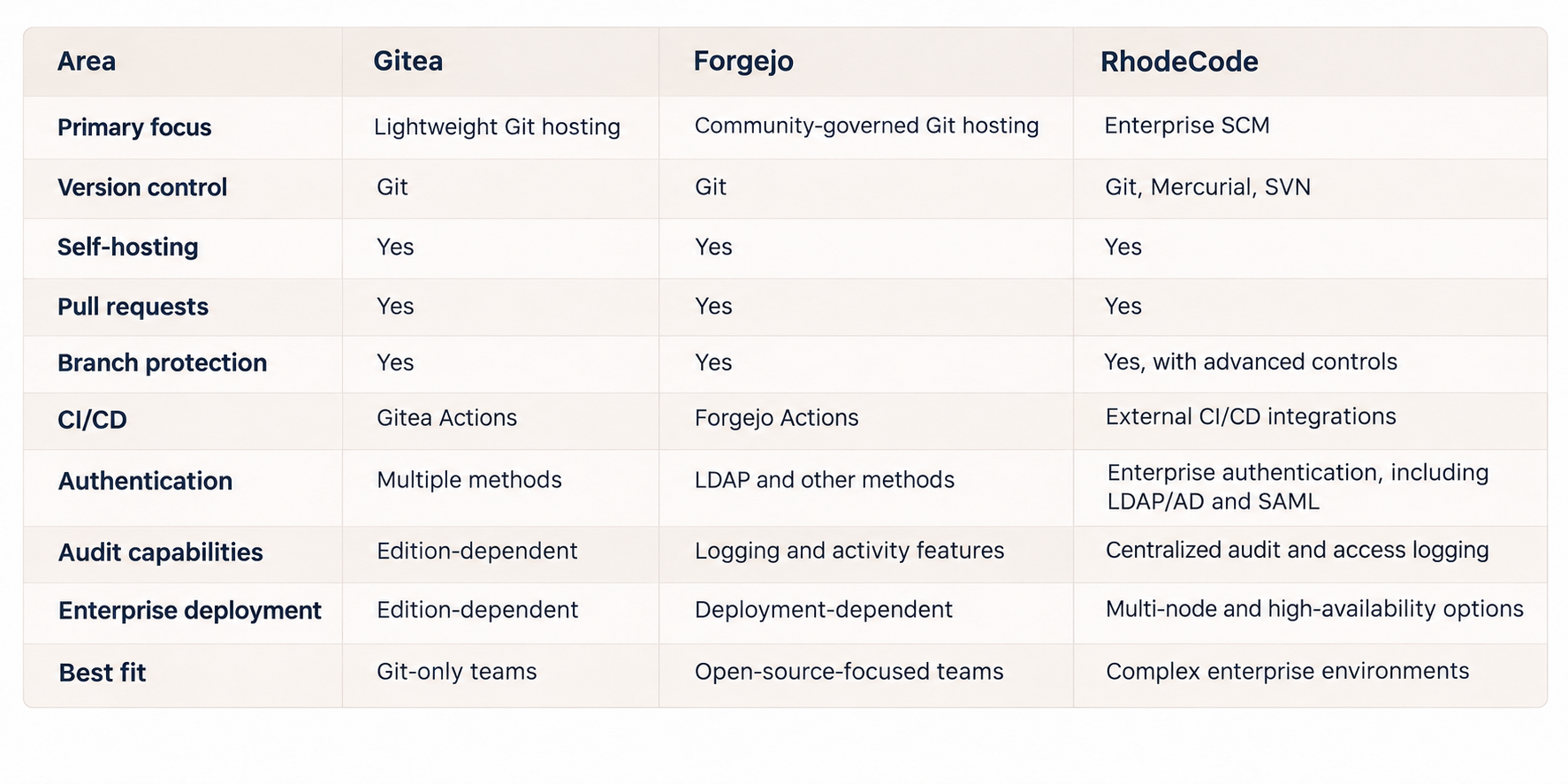
Capabilities depend on version, configuration, and licensing edition.
Gitea and Forgejo primarily address Git hosting and collaboration. RhodeCode extends repository management across multiple version control systems with centralized enterprise controls.
Why Forgejo Forked from Gitea
Forgejo emerged in 2022 following concerns about Gitea's ownership and governance. Maintainers wanted a community-controlled alternative independent of commercial ownership.
Forgejo operates under the nonprofit Codeberg e.V. umbrella. Gitea combines open-source development with commercial enterprise offerings.
Both platforms share technical origins and provide familiar Git workflows: repositories, pull requests, permissions, branch protection, and automation.
Forgejo moved toward an independent codebase in 2024, allowing its maintainers to follow a separate development roadmap.
Gitea vs Forgejo: Which Approach Is Better?
Gitea may appeal to organizations seeking lightweight Git hosting with a commercial support and enterprise product path.
Forgejo may suit organizations prioritizing software freedom, transparent governance, and community independence.
Neither model automatically guarantees better performance or security. Actual differences depend on release versions, available features, infrastructure, and support requirements.
See Forgejo's official comparison with Gitea for additional background.
Self-Hosted Git Hosting vs Enterprise Source Code Management
Self-hosting determines where repositories are stored. Enterprise source code management determines how those repositories are controlled.
Git-only teams may find Gitea or Forgejo sufficient. Both offer private repositories, collaboration features, and automation without requiring a large development platform.
Enterprise environments introduce additional requirements: centralized identity, consistent permissions, audit evidence, availability, and repository ownership across departments.
Another important distinction is version control support.
Gitea and Forgejo support Git. RhodeCode supports Git, Mercurial, and SVN within one platform.
This matters when financial institutions, manufacturers, or companies with legacy systems cannot immediately migrate every repository to Git.
RhodeCode allows teams to maintain existing version control systems while applying centralized administrative and collaboration processes.
Our guide to enterprise source code management software explains these requirements in more detail.
Security, Permissions, and Compliance
Security is one of the most important criteria when evaluating an enterprise Git server.
Private repositories alone cannot prevent unauthorized changes, excessive access, or weak review practices. Organizations need controls that remain consistent as teams and repositories grow.
Authentication and Git Access Control
Gitea supports repository permissions, protected branches, and external authentication. Its Enterprise offering adds commercial capabilities.
Forgejo provides repository access controls, branch protection, and authentication integrations, including LDAP.
RhodeCode supports centralized user, group, repository, and repository-group permissions.
RhodeCode Enterprise extends these controls with enterprise authentication, advanced branch permissions, and repository governance.
Centralized policies become particularly valuable when different departments require different levels of access to source code.
Code Review and Branch Protection
All three platforms support pull requests and review workflows. Protected branches restrict changes to critical code. Review requirements add another control by defining how modifications are approved.
RhodeCode supports code review across Git, Mercurial, and SVN. Enterprise reviewer rules help organizations standardize approval requirements for sensitive repositories. This reduces reliance on manually maintained processes across separate teams.
Repository Audit Logs
Git history records code changes but does not provide a complete audit trail of repository administration.
Security teams may need visibility into authentication, permissions, repository operations, and review decisions.
Gitea provides audit logging, with additional capabilities depending on edition. Forgejo includes logging and activity features, although audit coverage must be checked against the deployed version.
RhodeCode provides centralized access and audit logging to support repository oversight and investigations.
For practical guidance, see Git Repository Security Best Practices for Enterprise Teams.
CI/CD and Code Review Workflows
Source control must integrate with testing, review, and deployment pipelines.
Gitea includes Gitea Actions, while Forgejo provides Forgejo Actions. Both let teams automate development workflows using separate runners.
Compatibility with GitHub Actions syntax can simplify adoption, although individual workflows and integrations still require testing.
RhodeCode takes a different approach. Rather than replacing existing CI/CD platforms, it integrates with external automation through APIs, webhooks, and supported integrations.
Organizations already using Jenkins, TeamCity, or other build systems can maintain their existing pipelines while centralizing repository governance.
This approach is useful when replacing SCM infrastructure should not require redesigning the entire delivery process.
RhodeCode also supports structured pull request workflows, reviewer controls, and review history.
Enterprise Scalability and Repository Management
Repository count alone does not determine scalability.Performance depends on repository size, concurrent users, storage, API traffic, CI workloads, and deployment architecture.
Gitea and Forgejo can operate efficiently with relatively modest infrastructure. Larger deployments require careful database, storage, runner, and application configuration.
Gitea's commercial Enterprise edition may provide additional deployment options.
RhodeCode Enterprise includes multi-node configurations, high availability, scalable code search, and centralized repository management.
These capabilities become important when availability and consistent administrative control are business requirements.
Example: Managing Git and SVN Together
Consider a company maintaining 1,200 repositories across several departments.
Most development happens in Git, but critical applications still depend on SVN. Security teams require centralized permissions, while developers already use Jenkins.
Gitea or Forgejo could host Git repositories, but SVN would require separate infrastructure.
RhodeCode can manage both version control systems through one SCM environment, reducing administrative fragmentation without requiring immediate migration.
This is particularly relevant for organizations modernizing legacy environments gradually.
Gitea Enterprise vs Forgejo vs RhodeCode Enterprise
Licensing, support, and operational costs should be evaluated together.
Gitea offers open-source and commercial Enterprise products. Forgejo follows a community-governed free software model, with professional support options available through external providers.
RhodeCode provides Community and Enterprise editions. Enterprise capabilities address advanced authentication, governance, deployment, and commercial support requirements.
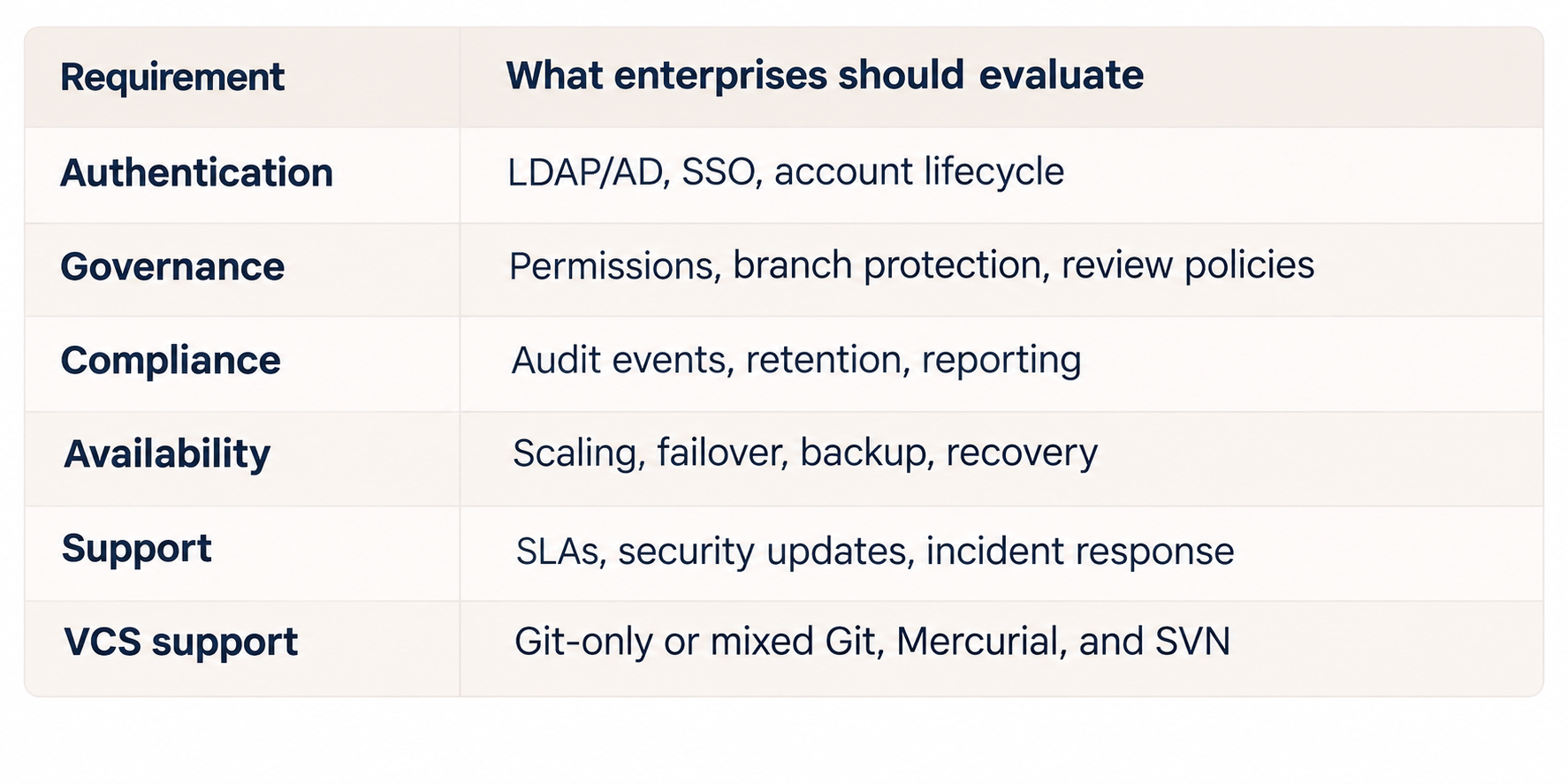
Total cost of ownership includes more than licensing.
Infrastructure, administration, migration, integrations, maintenance, and incident recovery all affect long-term costs.
Lower licensing costs may offer little benefit if organizations must maintain several separate SCM systems or build missing controls internally.
Which Self-Hosted Git Platform Should You Choose?
Platform selection should reflect existing systems and operational priorities rather than feature counts.
Choose Gitea when teams work exclusively with Git, prefer lightweight self-hosted Git hosting, and want integrated automation with an optional commercial enterprise path.
Choose Forgejo when community governance, free software independence, and straightforward Git collaboration are primary requirements.
Choose RhodeCode when organizations need centralized enterprise git repository management, advanced permissions, auditability, and unified support for Git, Mercurial, and SVN.
RhodeCode is particularly relevant when departments operate different version control systems or require consistent source code governance across multiple repositories.
Why Consider RhodeCode?
RhodeCode combines repository management, code review, permissions, and enterprise governance without requiring organizations to standardize immediately on Git.
Its support for multiple VCS technologies helps enterprises modernize existing environments while retaining established CI/CD infrastructure.
For organizations evaluating Gitea alternatives, this broader SCM approach can be more valuable than adding another Git-only hosting service.
Explore RhodeCode Enterprise to review its security, deployment, and integration capabilities, or request a demo to evaluate the platform against your requirements.
FAQ
What is the main difference between Gitea and Forgejo?
Gitea and Forgejo share technical origins but follow different governance and development models. Gitea offers open-source and commercial enterprise products, while Forgejo emphasizes community-controlled free software.
Is Forgejo better than Gitea for enterprise use?
Neither is universally better. Forgejo may appeal to organizations prioritizing open-source independence, while Gitea offers a commercial enterprise product path. Selection depends on features, support, deployment, and security requirements.
How does RhodeCode compare to Gitea?
Gitea focuses on Git hosting and collaboration. RhodeCode supports Git, Mercurial, and SVN with centralized repository management, permissions, code review, auditing, and enterprise deployment options.
Which platform provides the best self-hosted Git security?
All three support security controls. Organizations should compare authentication, repository permissions, branch protection, audit capabilities, deployment security, and maintenance requirements. Configuration remains essential regardless of platform.
Can these platforms integrate with existing CI/CD tools?
Yes. Gitea and Forgejo provide Actions-based automation. RhodeCode integrates with external CI/CD infrastructure through APIs, webhooks, and supported integrations.
Does RhodeCode support SVN and Mercurial?
Yes. RhodeCode supports Git, Mercurial, and Subversion through one repository management environment, making it relevant for enterprises with mixed version control systems.
Is RhodeCode suitable for large enterprise deployments?
RhodeCode Enterprise offers multi-node deployment, high availability, advanced authentication, and centralized repository governance. Actual capacity should be validated against the organization's workload.
What should teams consider before migrating from Gitea or Forgejo?
Migration planning should cover repository history, branches, users, permissions, pull requests, integrations, CI/CD workflows, and rollback procedures. Repository data transfer alone does not guarantee a complete migration.