Pull Request Best Practices for Enterprise Teams
Learn pull request best practices for enterprise teams, including code reviews, approvals, CI/CD checks, branch protection, and scalable workflows.
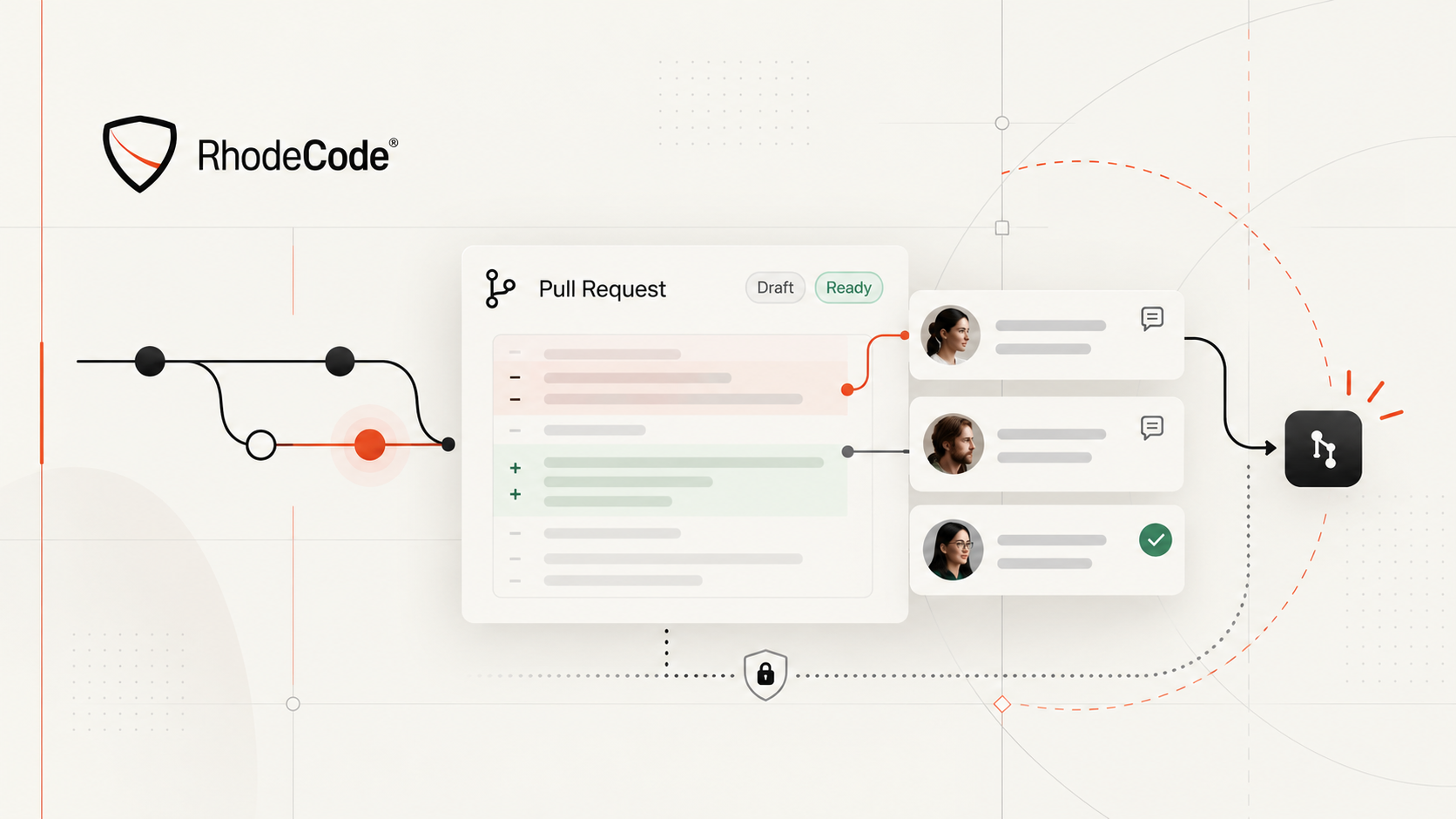
One pull request can delay an entire release. Code is ready, tests pass, but changes remain unmerged because reviewers are overloaded, approvals are unclear, or another pull request must merge first.
Across hundreds of repositories and dozens of engineering teams, these delays turn code review into a delivery bottleneck.
Effective pull request management requires clear ownership, predictable approvals, automated validation, and control over changes before they reach protected branches.
This guide covers pull request best practices for enterprise teams and explains how RhodeCode helps scale code review without compromising security or development speed.
TL;DR
- Keep pull requests focused, with clear descriptions and assigned reviewers.
- Automate CI/CD checks and apply risk-based approval requirements.
- Use draft pull requests and explicit dependencies for incomplete or related changes.
- Protect critical branches and maintain traceable review decisions.
- Measure review delays and merge readiness to identify bottlenecks.
What Is a Pull Request Workflow?
Pull request workflow defines how developers propose, review, validate, approve, and merge code changes.
Developer creates a branch, implements changes, and opens a pull request against a target branch. Reviewers evaluate the code, automated checks verify technical requirements, and authorized contributors approve the merge.
Enterprise workflows add complexity. Changes may affect shared libraries, infrastructure, regulated data, or components owned by multiple teams.
Effective code review workflow must answer five questions: What changed? Who owns the code? Which checks must pass? Who approves the change? What prevents unsafe merging?
Without clear rules, teams face inconsistent reviews, delayed approvals, and unnecessary production risks.
RhodeCode's guide to how pull requests work covers the fundamentals.
Enterprise environments require additional governance and automation.
Why Pull Requests Become Bottlenecks at Scale
Review Queues and Oversized Changes
Senior engineers often become default reviewers for critical services and security-sensitive code. Their availability can determine when multiple teams release.
Large pull requests increase review time. Reviewers need more context, feedback arrives later, and branches continue diverging.
Important distinction is between active review time and waiting time. Change may require 20 minutes of review but remain open for three days before someone starts. Reducing waiting time often delivers greater value than accelerating the review itself.
Unclear Ownership and Approval Rules
Enterprise repositories frequently contain components owned by different teams.
Authentication changes may require security approval, while infrastructure modifications need platform-team review. Without defined ownership, developers spend time finding appropriate reviewers.
Excessive approval requirements create additional delays. Effective pull request approval best practices match reviewer involvement to the risk and ownership of each change.
Missing Automation
Human reviewers should evaluate design, maintainability, security implications, and business logic.
Formatting, compilation, automated testing, and repeatable policy checks belong in CI/CD.
Without reliable automation, reviews become slower and more dependent on individual judgment.
Pull Request Best Practices for Enterprise Teams
1. Keep Pull Requests Small and Focused
Each pull request should address one clear objective.
Combining unrelated refactoring, dependency updates, and bug fixes makes changes harder to review, test, and revert.
No universal line-count limit works for every project. Better measure is whether reviewers can understand the purpose, assess risks, and validate behavior without excessive context switching.
2. Standardize Pull Request Descriptions
Pull request template best practices focus on giving reviewers the information they need.
Descriptions should explain the problem, implementation approach, affected components, testing performed, and deployment risks.
High-risk changes may also require rollback considerations.
Templates should remain lightweight. Excessive documentation requirements add overhead without improving code quality.
3. Assign Reviewers Based on Ownership
Reviewer assignment should reflect the code being modified.
Authentication, payment services, infrastructure, and frontend components often require different expertise.
RhodeCode supports reviewer assignment and code review workflows that help organizations manage review responsibilities and feedback.
Clear ownership reduces delays and prevents critical changes from reaching reviewers without the necessary context.
4. Apply Risk-Based Approval Requirements
Approval should reflect an informed technical decision.
Routine changes may need one qualified reviewer. Security-sensitive modifications may require additional approval.
Policies should also define what happens when new commits are added, target branches change, or approvals become outdated.
Clear requirements improve accountability without turning every review into a lengthy approval chain.
5. Make Review Feedback Actionable
Pull request comments best practices emphasize specific, useful feedback.
Instead of writing "This looks wrong," reviewers should explain the concern, affected behavior, and suggested improvement.
Blocking issues must be distinguishable from optional recommendations.
RhodeCode supports inline comments, discussions, and review tasks, keeping feedback connected to code changes.
6. Automate CI/CD Validation
Automated checks should validate builds, tests, code quality, dependencies, and relevant security policies.
Passing tests cannot guarantee correct software, but automation reduces repeatable errors and allows reviewers to focus on higher-level decisions.
RhodeCode supports integrations with automated QA workflows, making validation part of the review process.
Effective git devops integration identifies failures before changes reach protected branches.
7. Protect Critical Branches
Branch protection limits how sensitive code can be modified.
Production and release branches should not accept unrestricted changes from every contributor with repository access.
RhodeCode supports branch-level permissions, including controls over force pushes and web-based merging.
Combined with reviewer rules and CI/CD checks, these controls help enforce consistent review requirements.
Learn more in Git Repository Security Best Practices for Enterprise Teams.
Pull Request Review and Approval Checklist
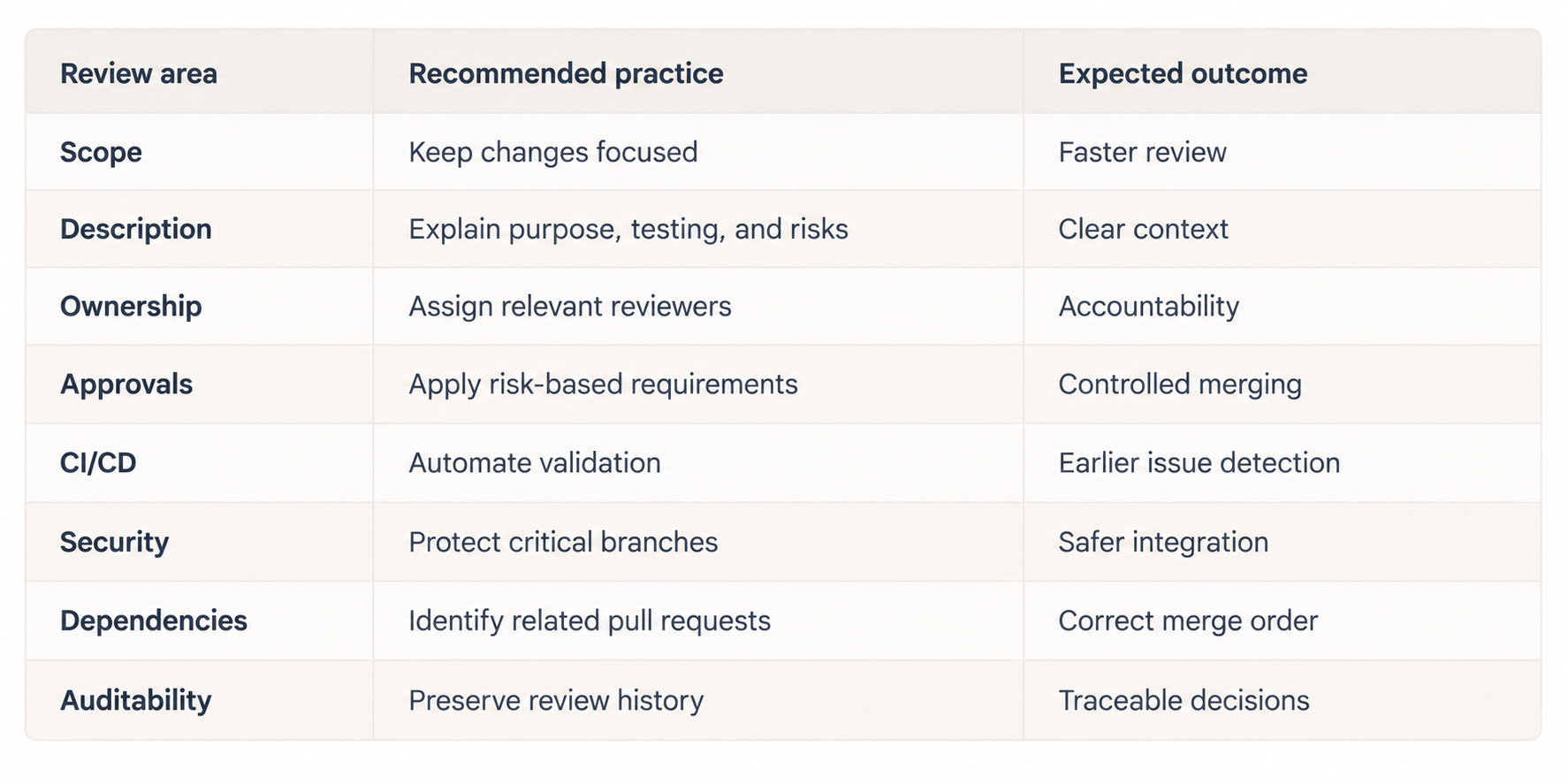
These code review process best practices provide consistent controls while accommodating different repository requirements.
Managing Draft Pull Requests and Dependencies
Enterprise development often involves related changes across APIs, services, and applications.
Combining everything into one pull request makes review difficult. Separating changes creates dependencies that must be managed.
Draft Pull Requests
Draft pull requests let developers share incomplete work and receive feedback before requesting formal approval.
Early reviews can identify architectural issues or incorrect assumptions while changes remain inexpensive to modify.
RhodeCode 5.15.0 introduced Draft/Ready controls, allowing developers to create draft pull requests and update their status.
Draft requests cannot merge until marked Ready, helping distinguish work in progress from merge-ready changes.
Pull Request Dependencies
Related pull requests may need to merge in a specific order.
For example, an API change may need to merge before the service and frontend changes that depend on it.
RhodeCode 5.15.0 introduced explicit pull request dependencies. Open dependencies block merging, reducing the risk of incorrect integration order.
Dependency discovery also respects repository permissions, preventing unauthorized visibility into restricted repositories.
Target Branch Changes and Approvals
Changing a pull request target may change its approval requirements.
Code originally targeting development might be redirected toward a protected release branch.
RhodeCode 5.15.0 recalculates reviewer rules and approvals when target branches change, helping prevent outdated approvals from being applied to a different destination.
See the RhodeCode 5.15.0 release notes for implementation details.
How to Improve the Code Review Process
Improvement starts with identifying where pull requests spend time.
Useful metrics include time to first review, approval waiting time, pull request age, time from approval to merge, and frequency of reopened discussions.
High waiting time often indicates insufficient reviewer capacity or unclear ownership.
Repeated review cycles may signal oversized changes or incomplete requirements.
Review metrics by team and repository. Organization-wide averages can hide specific bottlenecks.
Speed must also be evaluated against production quality. Faster merging is not an improvement if deployment failures or emergency fixes increase.
Goal is predictable delivery with appropriate controls, not maximum merge volume.
What Enterprise Code Review Tools Should Provide
Enterprise code review tools need more than a convenient pull request interface.
Organizations require reliable permissions, identity integration, auditability, CI/CD compatibility, and centralized repository administration.
Infrastructure control is another consideration. Teams working with proprietary source code, regulated workloads, or restricted networks may prefer self hosted code review tools.
Repository diversity also matters. Enterprises often maintain Git alongside Mercurial or SVN.
Effective enterprise git repository management must support existing development workflows without forcing unnecessary infrastructure changes.
Our guide to enterprise source code management software explains these requirements in greater detail.
How RhodeCode Supports Enterprise Pull Request Workflows
RhodeCode Enterprise combines repository management, code review, permissions, and integrations in a self-hosted environment.
Supporting Git, Mercurial, and SVN, RhodeCode helps organizations centralize governance without requiring every project to use the same version control system.
Code Review and Collaboration
RhodeCode provides pull request reviews, inline comments, reviewer assignment, review tasks, and merge workflows.
Discussions remain connected to the relevant code, while review history helps teams understand previous decisions.
Repository Security and Governance
Repository permissions, branch-level controls, and audit capabilities support consistent policies across teams.
Organizations can restrict access to sensitive code, manage approval responsibilities, and maintain accountability.
Automation and Integrations
RhodeCode integrates with automated QA and existing development tools.
Teams can incorporate testing and issue tracking into repository workflows without replacing their established CI/CD infrastructure.
Modern Pull Request Management
RhodeCode 5.15.0 adds Draft/Ready status, explicit pull request dependencies, and safer target-branch changes.
These capabilities help teams manage incomplete work, coordinate merge order, and keep approval requirements aligned with the destination branch.
Combined with centralized git repository management, they help reduce operational complexity as engineering teams scale.
Explore RhodeCode Enterprise to see how controlled code reviews and repository governance fit into your development environment.
Scale Code Review Without Losing Control
Efficient pull request workflows combine focused changes, clear ownership, reliable automation, and enforceable approval requirements.
RhodeCode brings code review and repository governance into one environment, helping teams maintain development speed without sacrificing control over source code and infrastructure.
Explore RhodeCode Enterprise to see how centralized reviews, permissions, and configurable workflows support enterprise engineering teams.
FAQ
What are pull request best practices?
Keep changes focused, document their purpose, assign relevant reviewers, automate tests, apply appropriate approvals, protect critical branches, and preserve review history.
How can teams improve the code review process?
Reduce waiting time, clarify ownership, split oversized changes, and automate repeatable checks. Track review performance alongside software quality.
How many approvals should a pull request require?
Requirements depend on risk and ownership. Routine changes may need one qualified reviewer, while critical or security-sensitive modifications may require additional approval.
What is the difference between draft and ready pull requests?
Draft requests communicate incomplete work or the need for early feedback. Ready requests indicate that changes can proceed through formal review and merge validation.
Why are pull request dependencies important?
Dependencies identify changes that must merge first. Explicit tracking helps teams coordinate related work and avoid incorrect merge order.
Are self-hosted code review tools suitable for enterprises?
Yes. Self-hosted platforms offer greater infrastructure control and can support internal identity, security, and compliance requirements. Organizations remain responsible for operating and securing their deployments.
How does RhodeCode support enterprise code review?
RhodeCode provides pull requests, reviewer controls, branch permissions, audit capabilities, and integrations across Git, Mercurial, and SVN. Version 5.15.0 also introduced draft pull requests and explicit dependency management.