Version control software records changes, preserves history, and enables developers to collaborate. Enterprise source code management adds the operational layer around repositories: authentication, permissions, code review, auditing, repository organization, integrations, automation, and infrastructure management. This distinction matters as an organization grows.
A small team may manage several Git repositories and a few users. An enterprise can have thousands of repositories across business units, different security policies, multiple version control systems, and infrastructure that cannot leave the corporate network. At that point, code repository management becomes an architectural decision rather than simply a developer tooling choice. If you are still comparing deployment options, our guide to self-hosted source code management platforms covers RhodeCode, GitHub Enterprise Server, GitLab Self-Managed, Gitea, Forgejo, and Bitbucket Data Center.
1. Start With Your Version Control Environment
The first question is not which product has the longest feature list. It is: What source code infrastructure do you already have? Many modern source code repository tools are primarily Git-focused. That works for organizations standardized on Git, but enterprise environments often include older SVN repositories, Mercurial projects, repositories inherited through acquisitions, and systems that cannot be migrated immediately. Before choosing a platform, determine which VCSs it supports, whether different repository types can be managed centrally, and whether permissions and workflows remain consistent across them. RhodeCode addresses this with a unified management layer for Git, Mercurial, and Subversion. This allows organizations to centralize repository management without making an immediate VCS migration a prerequisite. For teams maintaining legacy codebases, understanding the role of Subversion in enterprise version control can also help determine which projects actually need migration.
2. Evaluate Security, Permissions, and Governance Together
Authentication alone does not make an SCM platform enterprise-ready. Enterprise source code can contain proprietary technology, infrastructure configuration, unreleased products, and other high-value intellectual property. Organizations therefore need control over both who can access the platform and what they can do inside it. Your source control management software should fit existing identity infrastructure and provide permissions granular enough to reflect how teams actually work. Depending on the environment, that may include enterprise authentication, LDAP or Active Directory integration, repository and group permissions, and differentiated read, write, and administrative access. Auditability is equally important. Security and platform teams should be able to determine who has access to critical repositories, how permissions changed, and what administrative actions occurred. As repository counts grow, these policies need to be managed centrally rather than repository by repository.
RhodeCode combines centralized permission management, enterprise authentication, audit capabilities, and repository governance across source code environments. The objective is simple: access should be explicit, manageable, and auditable.
3. Decide Where Your Enterprise Source Code Can Live
The deployment model affects security, compliance, operations, and long-term control. Some organizations are comfortable with public SaaS infrastructure. Others require their enterprise source code repository to remain inside infrastructure they control because of internal security policies, customer contracts, data residency requirements, regulated environments, or isolated networks. If those restrictions apply, examine what a vendor actually means by “self-hosted” or “self-managed.”Can the full platform operate behind your firewall? Can repositories, authentication, databases, backups, and critical integrations remain within the required network boundary?
RhodeCode is designed for organizations that want to keep source code infrastructure under their own control while centrally managing Git, Mercurial, and SVN. For Git-specific requirements, the guide to secure enterprise Git management goes deeper into hosting, security, and enterprise workflows.
4. Treat Code Review as Part of Source Code Management
Repositories are not simply storage. SCM sits between writing code and shipping it. That makes code review an important part of evaluating version control management software. Teams need workflows for reviewing changes, discussing them in context, approving updates, resolving issues, and maintaining consistent quality controls across projects.
For enterprise teams, consistency matters as much as individual features. Informal review processes that work for one development team become difficult to maintain across dozens of teams and thousands of repositories.
RhodeCode integrates code review and collaboration into the repository workflow across its supported version control systems, allowing organizations to maintain a more consistent process around source changes.
5. Make Sure the SCM Fits Your Existing Toolchain
Replacing SCM should not require replacing every system around it.
Most enterprise engineering organizations already have CI/CD, issue tracking, identity management, monitoring, security tooling, and internal automation. A new platform needs to work with that environment.
When comparing source control management tools, examine the quality of APIs, webhooks, CI/CD integrations, authentication integrations, and automation capabilities. The important question is not simply how many features the SCM includes, but whether it can become part of your existing engineering architecture. There are two valid approaches: an all-in-one development platform or a focused SCM layer that integrates with specialized tools. For organizations with a mature toolchain, the second model can avoid replacing systems that already work. RhodeCode supports APIs, hooks, and integrations for connecting source code management with existing enterprise development workflows.
6. Plan for Scale and Availability
Repository count alone does not define enterprise scale. When evaluating enterprise version control, consider the number of repositories and users, repository size, CI and API traffic, geographic distribution, availability requirements, and recovery expectations.
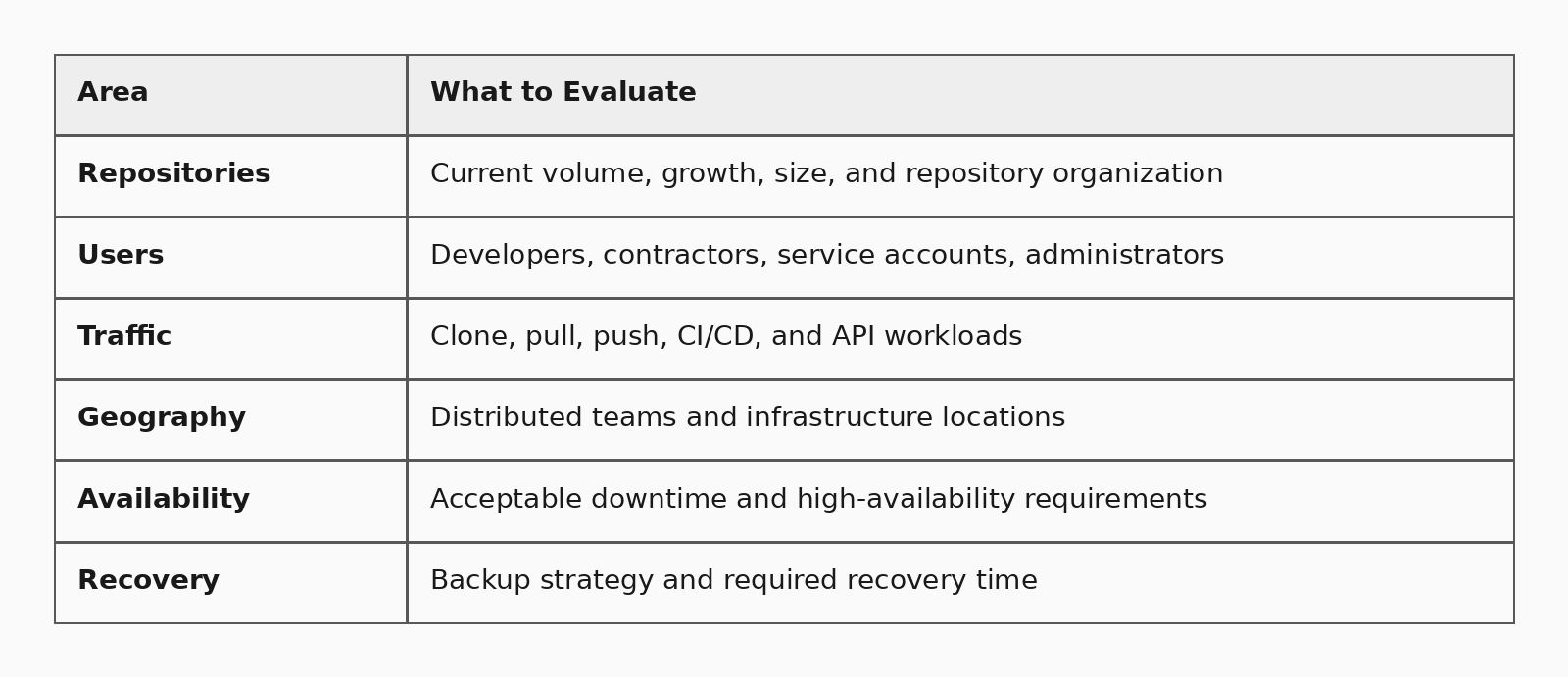
Do not evaluate only for today's workload. Moving an enterprise source code repository can be disruptive, so the platform needs a credible path from current requirements to future scale. For larger RhodeCode environments, these enterprise source code management best practices cover repository organization, infrastructure stability, security, and scaling.
7. Look Beyond Individual Repositories
Developers interact with repositories individually. Platform teams manage them collectively. This distinction matters.
As an organization grows, administrators need efficient ways to organize repositories, apply permissions, manage users, automate repetitive tasks, identify ownership, and maintain policies across projects.
This is where code repository management and Git repository management become more than hosting. When comparing Git repository tools, code repository tools, or broader software repository tools, evaluate the administrative experience as seriously as the developer interface. A platform that requires manual administration for every repository can create significant overhead at enterprise scale.
8. Treat Migration as a Product Requirement
Migration is often considered only after a platform has been selected. It should be part of the selection process.
Moving source control may involve far more than repositories. History, branches, tags, users, permissions, hooks, CI/CD connections, integrations, and development workflows can all be affected.
The important question is whether everything needs to migrate at once. For organizations with substantial legacy infrastructure, running old and new version control systems in parallel can reduce risk. Projects can move according to business priority while existing repositories remain operational.
This is particularly relevant to RhodeCode's multi-VCS approach. Git, Mercurial, and SVN repositories can coexist within the same management environment, making gradual modernization possible without requiring a single disruptive migration.
If SVN modernization is part of the roadmap, a staged SVN-to-Git migration can reduce the risk of a large cutover.
9. Measure Operational Complexity, Not Just License Cost
The price of enterprise source code management software is only one component of its real cost. Infrastructure, administration, upgrades, backups, monitoring, migration, integration work, security management, and incident recovery all contribute to total cost of ownership.
A cheaper platform can become expensive if it requires significant engineering effort to operate. Conversely, an all-in-one platform can introduce unnecessary cost and complexity if most of its functionality duplicates tools the organization already maintains.
Instead of asking only “How much does the license cost?”, ask: “How much operational complexity does this platform introduce relative to the problems it removes?” That question usually produces a more realistic enterprise comparison.
Enterprise Source Code Management Checklist
Before choosing a platform, verify five areas:
- Infrastructure: Does it support your VCS landscape, deployment model, scale, availability, and disaster recovery requirements?
- Security: Does it provide the authentication, permissions, auditing, and governance your organization needs?
- Engineering workflow: Are code review, CI/CD, APIs, integrations, and automation compatible with how your teams work?
- Migration: Can repositories and workflows move without unnecessary disruption or a forced all-at-once migration?
- Operations: Can your team realistically deploy, upgrade, monitor, back up, secure, and support the platform over time?
A long feature list is useful only if the platform meets these underlying requirements.
Where RhodeCode Fits
RhodeCode is designed for organizations that need centralized control over source code while keeping the platform within the infrastructure they control.
Its key distinction is unified management for Git, Mercurial, and SVN, combined with repository permissions, code review, auditing, integrations, and enterprise deployment capabilities. This is particularly relevant when multiple VCS technologies coexist, source code must remain behind the firewall, governance is important, or legacy repositories cannot be migrated immediately.
For a small Git-only team, simpler source code management tools may be sufficient. The value of an enterprise SCM platform becomes more apparent as repository counts, users, security boundaries, integrations, and legacy infrastructure increase.
Choosing the Right Enterprise Source Code Management Software
There is no universal “best” platform. A Git-only organization may prioritize ecosystem and developer familiarity.
A regulated enterprise may care more about deployment control and auditability. A company with decades of source history may need to maintain SVN or Mercurial while modernizing gradually. Start with those constraints.
Document your VCS landscape, security model, deployment requirements, integrations, expected scale, and migration limitations. Then evaluate platforms against those requirements rather than adapting your requirements to whichever product has the longest feature list.
The right enterprise source code management software should give developers an efficient way to work while giving the organization sustainable control over its source code.
If your environment includes Git, Mercurial, or SVN and you need centralized repository management on infrastructure you control, RhodeCode is built for that use case. Explore RhodeCode Enterprise and start a 30-day trial, or contact the RhodeCode team to discuss your SCM requirements.