
Trunk-Based Development vs GitFlow: Which Works Better at Scale?
Compare trunk-based development vs GitFlow for enterprise teams, including CI/CD, branching strategies, code reviews, release management, and Git governance.
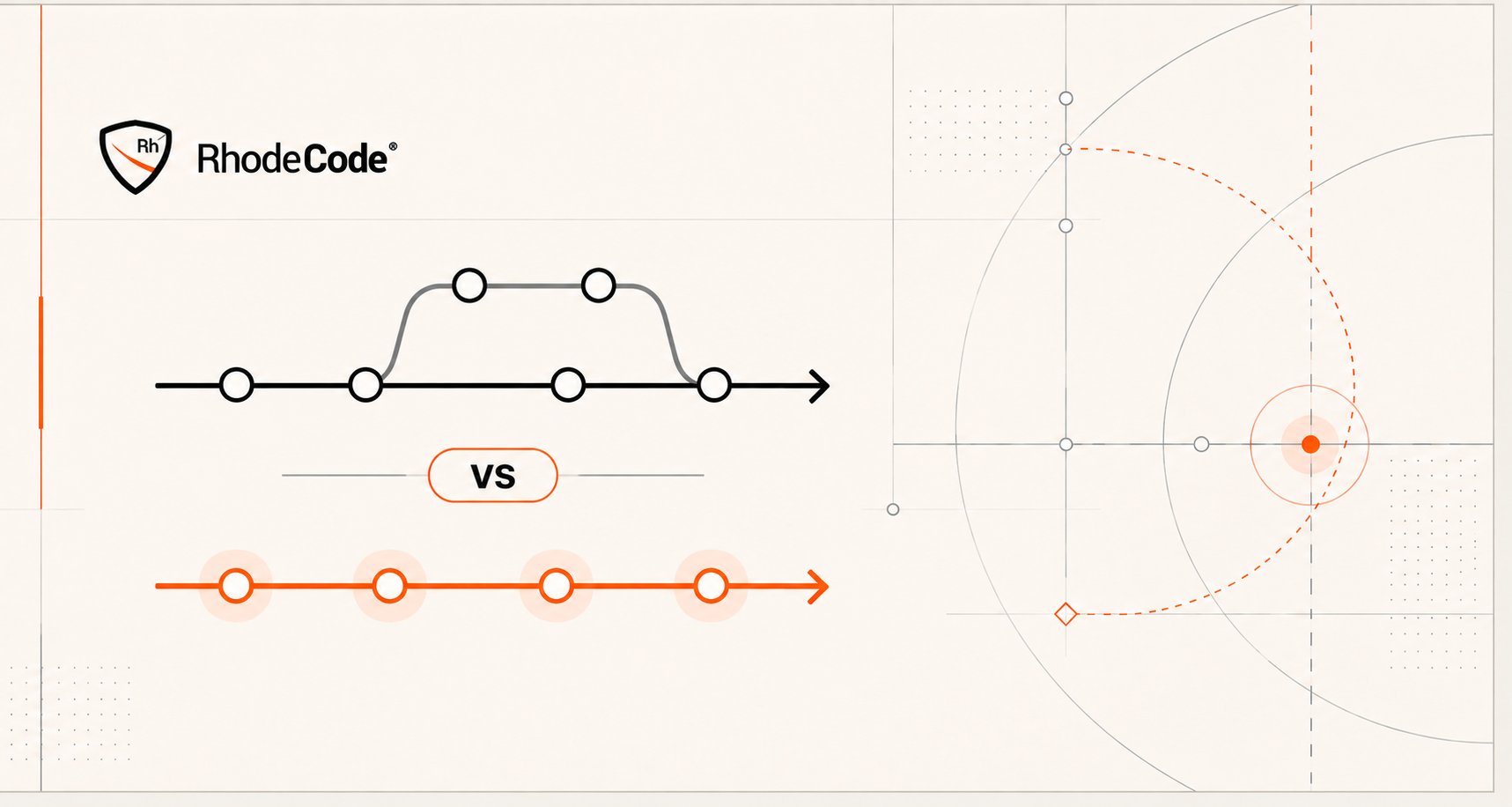
Branching strategy rarely becomes a problem when five developers work on one application. Problems appear when dozens of teams maintain hundreds of services, releases move at different speeds, CI pipelines become expensive, and a feature branch stays open long enough to become its own version of the product.
At that point, choosing between trunk-based development and GitFlow is no longer a matter of developer preference. Branching affects integration speed, code review workload, release coordination, rollback strategy, CI/CD design, and ultimately how quickly software can move safely into production.
Trunk-based development optimizes for frequent integration. GitFlow optimizes for explicit separation between development and release stages. Both can work at enterprise scale, but they create very different operating models.
TL;DR
- Trunk-based development works best when teams integrate frequently, automate testing, keep changes small, and deploy continuously or often.
- GitFlow works well when releases require explicit stabilization periods, multiple supported versions, or formal release coordination.
- Scale makes long-lived branches increasingly expensive because integration, review, and conflict resolution happen later.
- Neither model replaces governance. Branch permissions, pull requests, CI checks, code review, and auditability still determine what can reach protected code.
- Many enterprises end up with a controlled trunk-based model or a hybrid rather than implementing either strategy exactly as described in a textbook.
What Is Trunk-Based Development?
Trunk-based development is a branching strategy in which developers integrate changes into one primary branch frequently.
Primary branch may be called main, master, or trunk. Work can happen directly on that branch in small teams, but larger organizations usually use short-lived feature branches and merge them back quickly.
Goal is simple: reduce the amount of time code diverges. Instead of allowing a feature branch to evolve independently for several weeks, developers break work into smaller increments. Incomplete functionality can remain disabled through feature flags or other release controls while code continues to integrate.
Git trunk-based development therefore separates two decisions that teams often treat as one: Integrating code does not have to mean releasing functionality.
Code can reach trunk while a feature remains unavailable to users. Deployment, configuration, feature flags, and release automation determine when functionality becomes active.
This distinction makes a trunk based branching strategy particularly compatible with continuous integration and modern version control in DevOps environments.
Frequent integration also changes the nature of code review. Pull requests tend to be smaller, feedback arrives earlier, and reviewers evaluate changes closer to the code currently running on trunk.
What Is GitFlow?
GitFlow uses several branch types to separate active development from production releases.
Classic Git flow branching strategy normally includes:
mainfor production-ready releasesdevelopfor integrated development work- feature branches created from
develop - release branches used to stabilize upcoming versions
- hotfix branches used for urgent production fixes
GitFlow workflow creates clear boundaries between development, release preparation, and production.
That separation can be valuable when software ships on defined release schedules or when teams must maintain several supported versions simultaneously. Release teams can stabilize one version without stopping development for the next.
Cost appears in coordination. Changes may pass through feature, develop, release, and main branches before reaching users. Every additional divergence point creates another opportunity for merge conflicts, duplicated fixes, delayed feedback, and differences between what developers test and what eventually ships.
GitFlow is therefore less about Git itself and more about release process design. RhodeCode's broader guide to the Git version control system also covers GitFlow, trunk-based development, merging, and rebasing in the context of enterprise Git workflows.
Trunk-Based Development vs GitFlow: Key Differences
Comparison becomes clearer when both approaches are evaluated as operating models rather than diagrams of branches.
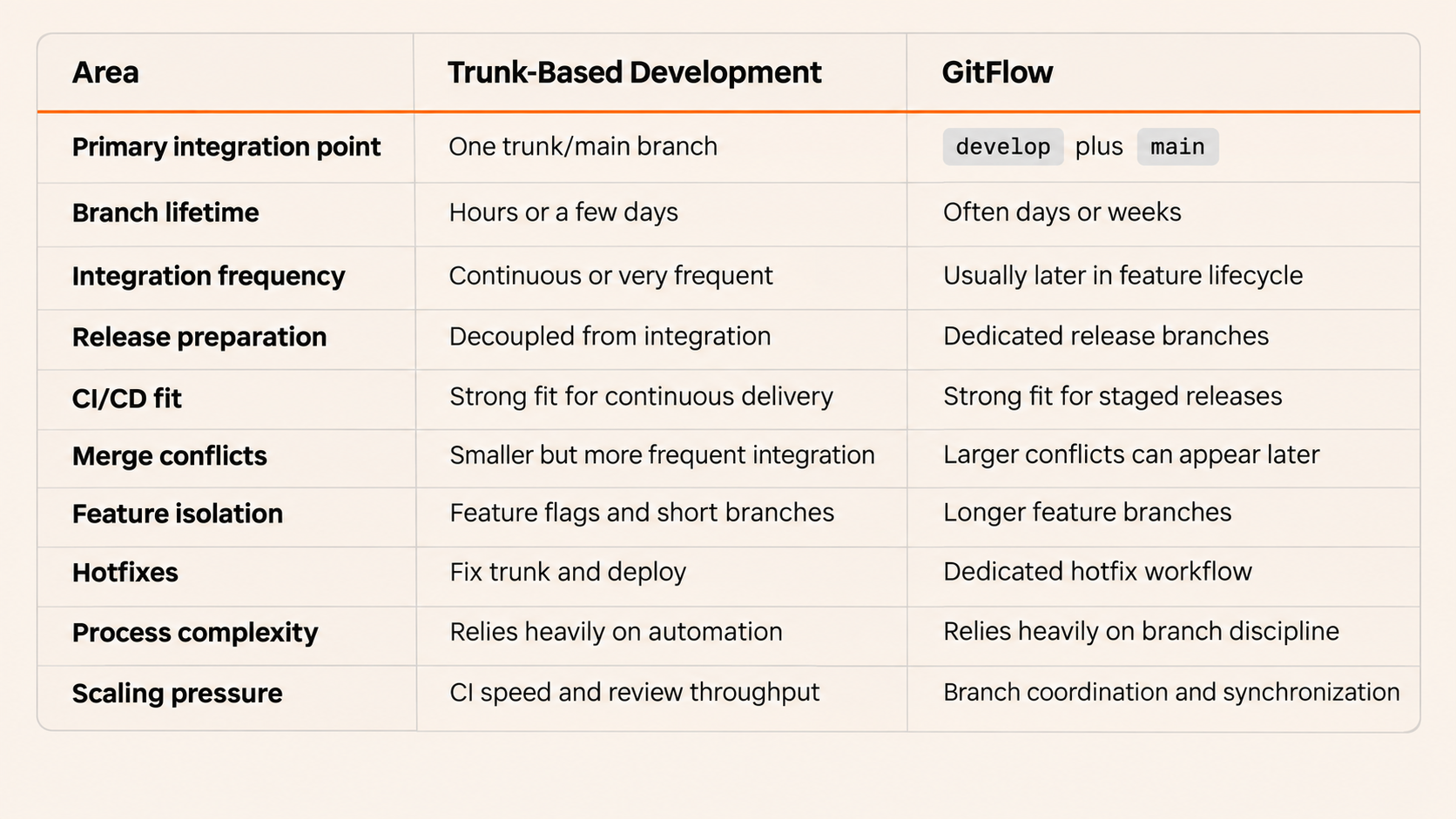
No row automatically makes one approach better. Correct choice depends on what the organization needs to optimize: integration speed, release separation, regulatory controls, supported versions, or operational simplicity.
Why Branching Strategy Changes at Scale
Small teams can compensate for weak process through communication. Enterprise teams cannot rely on everyone knowing which branch is safe to modify or which release contains a specific fix. Three pressures become more important as engineering organizations grow.
Integration Cost Grows with Branch Age
Long-lived branches accumulate assumptions. Dependencies change. APIs evolve. Infrastructure configuration moves. Shared libraries receive updates. Another team modifies the same area of the codebase.
Merge conflict represents only the visible part of that divergence. More dangerous problems are semantic conflicts where Git merges successfully but two changes no longer behave correctly together.
Useful metric here is branch half-life: how long typical development branches remain separated from the primary integration branch.
Median branch age moving from hours to several days is often more informative than simply counting branches. Longer branch half-life means integration risk is being postponed rather than removed.
Trunk-based development reduces that delay by design. GitFlow can control it too, but teams need stronger discipline around feature branch duration and synchronization with develop.
Code Review Can Become a Queue
Code review workflow often becomes the real bottleneck before Git does. Large pull requests take longer to understand. Reviewers postpone them. Authors continue developing while waiting, which makes the branch diverge further. Requested changes then add another review cycle.
Short-lived branches create pressure to make changes independently reviewable. That does not mean lowering review standards. It means moving complexity out of giant pull requests and into incremental changes that CI and reviewers can evaluate faster.
RhodeCode provides pull requests, manual review workflows, automated QA integration, reviewer controls, and review history across supported repositories. Learn more about RhodeCode's productivity features.
Release and Deployment Are Different Problems
GitFlow often becomes attractive because teams want stronger control over releases. Release control is necessary. Long-lived release branches are only one way to achieve it.
Modern CI/CD can keep trunk deployable while feature flags, environment promotion, artifacts, and deployment policy determine what reaches production. This model supports git devops integration without requiring every release state to exist as a permanent branch.
Other environments genuinely need release branches. Embedded software, customer-managed deployments, long support windows, or products with multiple maintained versions may need separate lines of development. Release branching strategy should follow product lifecycle rather than habit.
When Trunk-Based Development Works Better
Trunk-based development usually scales better when an organization optimizes for high integration frequency.
Teams need reliable automated testing, fast CI feedback, small changes, and confidence that trunk remains usable. Feature flags or equivalent controls become important when implementation must integrate before functionality is ready for release.
Benefits become especially visible in environments with microservices or frequent deployment.
Change enters the shared codebase earlier. Integration failures appear sooner. Developers spend less time synchronizing branches. CI validates code that is closer to the state other teams are actually using.
Enterprise Git governance still matters.
Direct unrestricted pushes to main are not a requirement of trunk-based development. Large organizations commonly implement trunk-based development through short-lived branches, mandatory review, CI validation, and controlled merge permissions.
RhodeCode's security controls support branch-level permissions that can restrict direct modification, force pushes, or require web-based merges for protected branches.
That makes it possible to combine short branch lifetime with enterprise controls rather than choosing between speed and governance.
When GitFlow Still Makes Sense
GitFlow remains useful where release states need to exist independently for meaningful periods.
Consider a product that ships a major version every quarter while development of the next release continues. Release engineers may need several weeks for certification, customer acceptance, security validation, or hardware testing. Hotfixes may also need to reach an already released version without including unfinished development.
Dedicated release branches make those states explicit.
GitFlow can also fit organizations where deployment is deliberately infrequent and releases move through formal approval gates.
Problems appear when GitFlow becomes a default template for teams that no longer need those constraints.
Using feature, develop, release, hotfix, and main branches for a SaaS product deployed several times per day can add process without adding meaningful control.
Gitflow vs trunk should therefore be decided from delivery requirements backward.
Trunk-Based Development, GitFlow, and Repository Architecture
Repository strategy changes the impact of branching decisions.
Monorepos increase the number of teams and components integrating through the same repository. Long-lived branches can become particularly expensive because one branch may diverge across many applications, services, libraries, and infrastructure files.
Trunk-based development often fits this model because frequent integration keeps shared dependencies synchronized.
Polyrepo environments distribute those conflicts across repositories, but coordination does not disappear. One feature may require compatible changes in several services. Long-lived branches in each repository can turn one release into a multi-repository synchronization problem.
Strong git repository management therefore matters regardless of architecture.
Enterprise teams need visibility across repositories, consistent permissions, repeatable review rules, and clear ownership. Our guide to enterprise source code management software covers those requirements in more detail.
How RhodeCode Supports Enterprise Git Branching Strategies
Branching model should not be hard-coded into the SCM platform.
Different teams may legitimately need different workflows. Platform team may use trunk-based development. Product with maintained customer releases may use GitFlow. Legacy project may still operate on SVN while newer services use Git.
RhodeCode Enterprise provides centralized source code management across Git, Mercurial, and SVN while allowing repositories and teams to maintain appropriate workflows. Repository grouping, enterprise-scale deployment, migration support, and centralized management help organizations operate mixed environments without forcing every project into the same model.
Branch permissions can control who can modify sensitive branches and whether modifications must go through pull requests. Repository permissions and audit logs add governance around that workflow. Code review tools provide a common approval process across supported version control systems.
Security becomes especially important when branching strategy changes. Moving from GitFlow toward trunk-based development, for example, should not mean simply deleting develop and allowing everyone to push to main.
Safer transition replaces branch separation with enforceable controls:
- Protect trunk and define who can merge
- Require review and CI validation for applicable changes
- Reduce feature branch lifetime gradually
- Separate deployment decisions from code integration
- Monitor branch age, pull request size, failed builds, and merge delays
RhodeCode's guide to Git repository security best practices explains how branch protection, access control, review, and auditing fit into broader repository governance.
Which Git Branching Strategy Works Better at Scale?
Trunk-based development is usually a stronger default for organizations pursuing continuous integration, frequent deployment, and fast feedback.
GitFlow remains a valid model when product lifecycle requires long stabilization periods, multiple maintained releases, or explicit release branches.
Scale itself does not choose the winner. Engineering system around the branches does.
Trunk-based development without reliable CI can turn main into a permanent incident. GitFlow without disciplined synchronization can create weeks of hidden integration work. Both fail when reviews take too long, ownership is unclear, or repository permissions do not match the intended process.
Best branching strategies in Git minimize the amount of work waiting to be integrated while preserving the controls the business actually needs.
For many enterprise teams, that means short-lived branches around a protected trunk, mandatory review, automated validation, and release controls outside Git wherever practical.
FAQ
What is trunk-based development?
Trunk-based development is a Git branching strategy where developers integrate changes into one main branch frequently. Larger teams typically use short-lived feature branches that merge back into trunk quickly rather than maintaining independent branches for long periods.
What is the main difference between trunk-based development and GitFlow?
Main difference is when integration happens. Trunk-based development integrates code continuously or very frequently. GitFlow separates development and releases through multiple branch types, including develop, release branches, and main.
Is trunk-based development suitable for large enterprise teams?
Yes, provided teams have strong CI, automated testing, review controls, and protected branches. Scale makes frequent integration more valuable, but also makes governance around the trunk more important.
Is GitFlow outdated?
No. GitFlow still fits products with scheduled releases, long stabilization periods, multiple maintained versions, or formal release gates. It becomes inefficient when teams use its additional branches without actually needing that release separation.
Can GitFlow and trunk-based development be combined?
Yes. Many organizations use hybrid models. Teams may keep short-lived branches and frequent integration for normal development while maintaining release branches only for versions that require extended support.
Does trunk-based development mean developers push directly to main?
No. Large teams can use short-lived feature branches, pull requests, CI checks, code review, and protected branch rules while still following trunk-based development principles.