
Monorepo vs Polyrepo: Which Works Better at Scale?
Monorepo vs polyrepo: compare Git performance, CI/CD, microservices, scalability, and enterprise repository management to choose the right strategy.
One repository can simplify collaboration. A hundred repositories can give teams independence. Both can become bottlenecks when repository architecture no longer matches how engineers work.
Growing organizations eventually face the same question: should applications, services, and shared libraries live in one Git repository or remain separate?
Choosing between monorepo vs polyrepo affects build performance, CI/CD costs, dependency management, code ownership, security, and release velocity.
Neither model guarantees scalability. Poorly configured monorepos create expensive builds, while fragmented polyrepo environments make cross-service changes difficult to coordinate.
This guide compares monorepo vs multi repo strategies, explains their trade-offs, and shows how enterprise teams can scale repository management without sacrificing control.
TL;DR
Monorepo stores multiple projects in one repository, simplifying shared changes and dependency coordination. Polyrepo separates projects into independent repositories, supporting team autonomy, access isolation, and independent releases.
Monorepo generally suits tightly coupled components. Polyrepo often fits independently deployed services and teams with different ownership or security requirements.
At enterprise scale, consistent permissions, code reviews, automation, and centralized repository management matter regardless of the chosen architecture.
What Is a Monorepo?
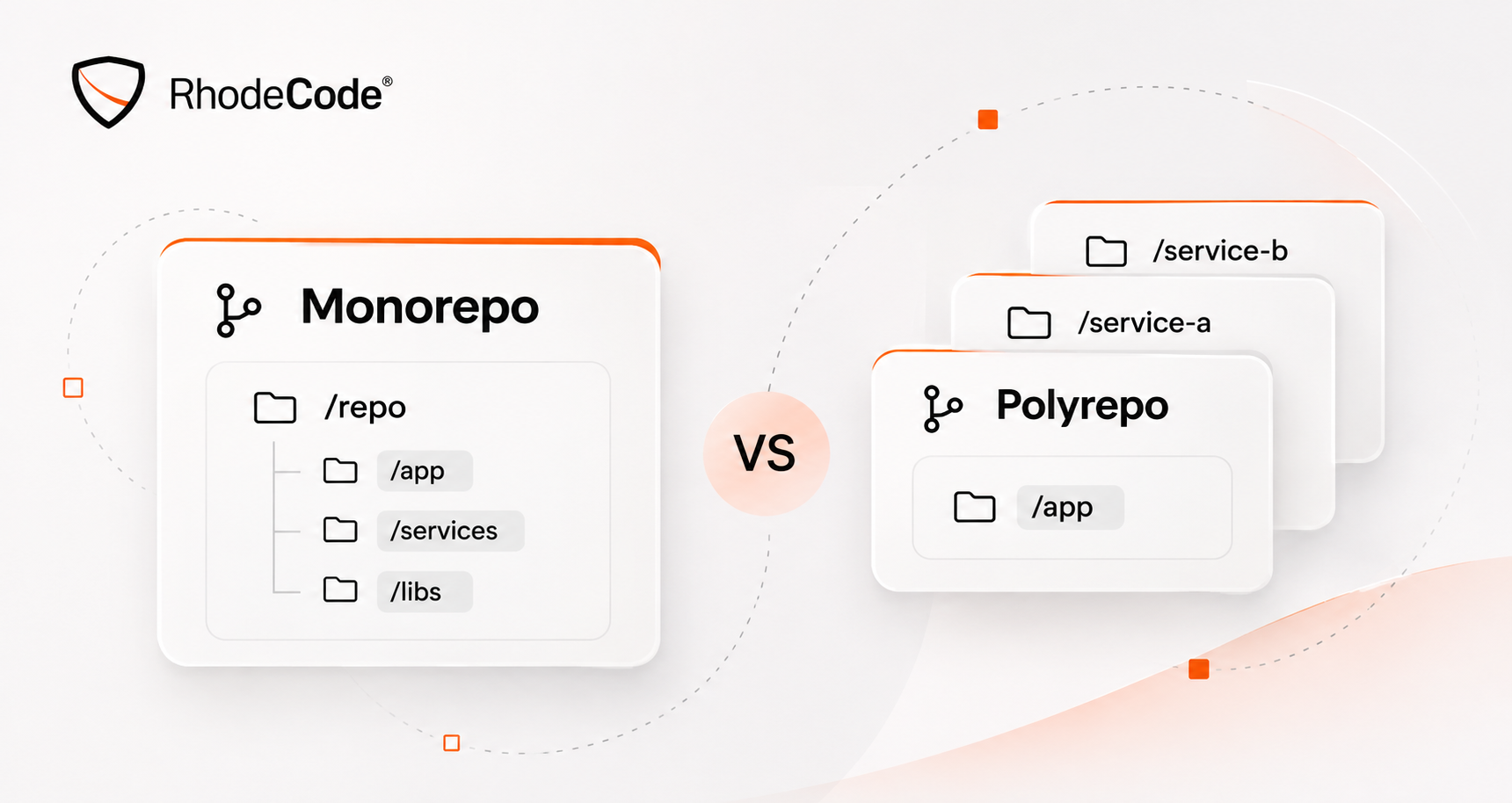
A monorepo stores multiple applications, services, or libraries within a single version control repository.
For example:

All components share repository history, making coordinated changes easier. Developers can update an API and its consumers in one pull request instead of synchronizing changes across separate repositories.
Shared tooling and dependencies also become easier to standardize.
However, larger repositories require efficient build pipelines, clear code ownership, and performance optimization.
Monorepo does not mean deploying every component together. Services can still have independent release processes.
What Is a Polyrepo?
Polyrepo, or multi-repo architecture, stores projects in separate repositories.

Each repository can have its own permissions, dependencies, CI/CD configuration, and release schedule.
This structure works well when teams own independent services with clearly defined interfaces.
However, changes affecting several services may require multiple pull requests, dependency updates, and coordinated releases.
As repository counts increase, effective multi repository management becomes essential to prevent inconsistent policies and fragmented workflows.
Monorepo vs Polyrepo: Key Differences
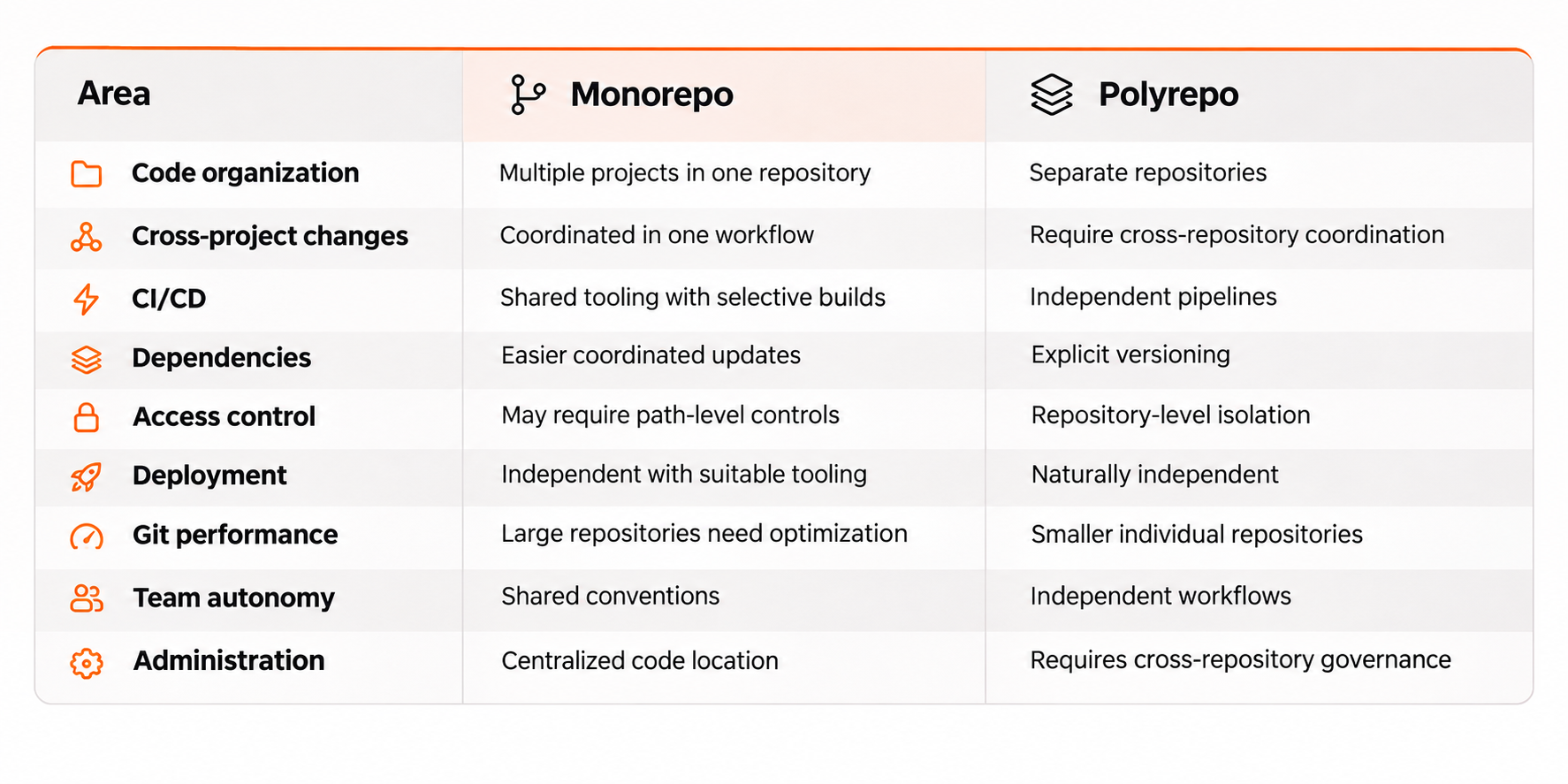
Repository Boundaries vs Team Boundaries
Repository architecture should reflect how teams collaborate. Closely coupled applications benefit from shared change visibility. Independent products often benefit from separate repositories.
Problems arise when repository boundaries conflict with ownership. Splitting tightly connected components creates coordination overhead, while placing unrelated teams in one repository can complicate reviews and access control.
Monorepo vs Polyrepo: Pros and Cons
Monorepo Advantages and Limitations
Monorepos offer several advantages:
- Coordinated changes: Update connected components in one pull request
- Consistent standards: Share tooling, testing, and development conventions
- Code visibility: Discover dependencies and related implementations more easily
- Simpler refactoring: Modify multiple components without coordinating separate repository releases
Limitations include growing repository history, complex CI/CD pipelines, shared tooling dependencies, and more difficult access separation.
Monorepo scalability depends on incremental builds, dependency-aware testing, and clear ownership.
Polyrepo Advantages and Limitations
Polyrepos provide independent release cycles, smaller individual repositories, and clearer repository-level access boundaries.
Teams can choose tools appropriate to their services without affecting unrelated projects.
However, cross-repository changes become harder to coordinate. Shared libraries require version management, while security and code review policies can diverge between repositories.
Effective multiple repository management requires consistent governance without eliminating team autonomy.
Git Performance and Repository Scalability
Repository architecture affects Git performance, but repository count alone does not determine scalability.
Large monorepos may increase clone times, checkout costs, indexing overhead, and CI execution time. Git offers several optimization mechanisms.
Optimizing Monorepo Performance
Partial clone reduces initial object downloads by deferring selected content. Sparse checkout limits which files appear in the working tree. Shallow clones can reduce CI download costs when full history is unnecessary.
Build optimization matters equally. Dependency-aware pipelines can run tests only for affected components instead of rebuilding every project after each commit.
Large binary assets require separate consideration. Git LFS helps manage large files without storing their full contents as ordinary Git blobs.
Performance in Polyrepo Environments
Smaller repositories typically reduce individual clone and checkout costs.
However, polyrepos introduce other expenses: repeated dependency downloads, cross-repository integration tests, and coordination between independent pipelines.
Performance should therefore be measured across the entire development workflow, including build times, dependency updates, CI costs, and deployment lead time.
Monorepo vs Multi-Repo for Microservices
Microservices architecture does not require a specific repository strategy. Monorepo can contain independently deployed services. A polyrepo can still contain tightly coupled applications.
When Monorepo Fits Microservices
Monorepo works well when services share libraries, APIs evolve together, or developers frequently modify multiple services within one feature. Shared visibility simplifies dependency management and coordinated changes. However, service-specific testing and deployment automation remain necessary.
When Polyrepo Fits Microservices
Polyrepo often fits independently owned services with stable interfaces, separate release schedules, or distinct security requirements.
For example, payment-processing code may require stricter access controls than a public-facing application. Separate repositories simplify that boundary.
Microservices monorepo vs multi repo decisions should follow service coupling, ownership, and operational requirements not service count.
Git Submodules vs Monorepo
Teams comparing submodules vs monorepo often want shared code without merging repositories.
Git submodules allow one repository to reference a specific commit from another repository.
This preserves independent histories while enabling projects to include externally maintained components.
However, submodules introduce additional complexity. Developers must initialize and update them correctly, CI pipelines need access to referenced repositories, and dependency changes require explicit updates.
Submodules work well for independently maintained, version-pinned dependencies. Monorepos are generally simpler when components require frequent coordinated changes.
Submodule vs monorepo decision should therefore depend on ownership and update frequency rather than repository size alone.
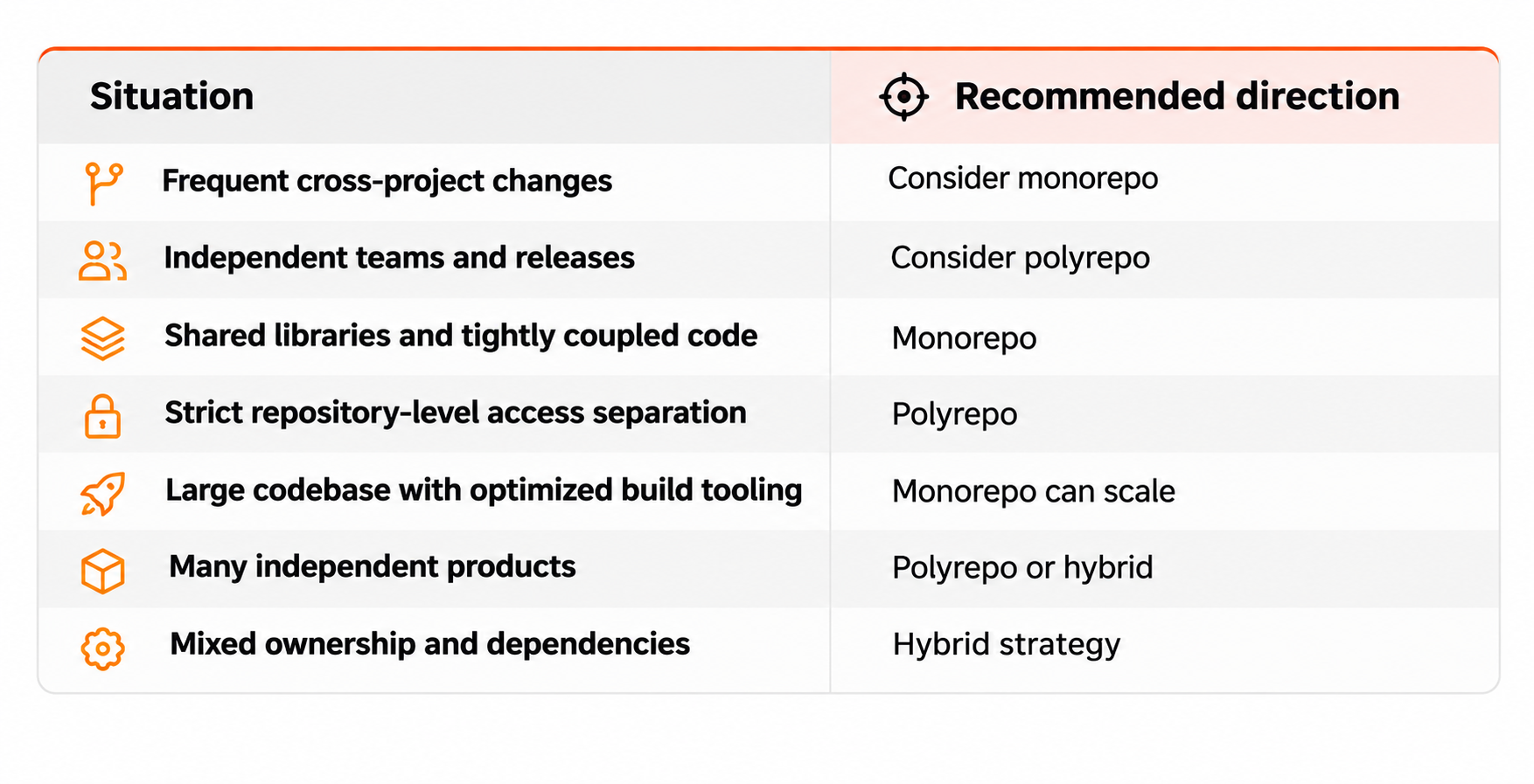
How to Choose the Right Repository Strategy
Repository architecture should reflect development workflows, not architectural trends.
Start by evaluating how often changes cross project boundaries, how independently services deploy, and whether teams require different access policies.
Validate Before Migrating
Repository restructuring affects Git history, CI/CD, dependencies, permissions, and developer tooling.
Before consolidating or splitting repositories, identify measurable problems.
Useful indicators include build duration, release coordination effort, onboarding time, dependency update frequency, and administrative overhead.
Migration should solve a demonstrated engineering problem.
Managing Multiple Repositories with RhodeCode
Polyrepo provides independence, but managing hundreds of repositories independently can create administrative complexity.
Enterprise teams need consistent authentication, permissions, code reviews, and visibility across projects.
RhodeCode provides a self-hosted source code management platform for Git, Mercurial, and SVN, helping organizations centralize repository governance while preserving project-level ownership.
Centralized Repository Management
RhodeCode supports fine-grained repository permissions, repository groups, centralized user management, and enterprise authentication.
Administrators can organize repositories around teams and projects while maintaining consistent access policies.
This is particularly valuable for enterprise git repository management, where developers, contractors, and automation services require different access levels.
Centralized administration reduces repetitive configuration without forcing every project into one repository.
Consistent Code Review Workflows
Independent repositories should not mean inconsistent review standards. RhodeCode provides code review workflows, branch controls, and repository permissions across supported VCS technologies.
Teams can review changes and manage approvals while maintaining a consistent governance approach. Our guide to Git Repository Security Best Practices explains how access control, protected branches, and auditing support secure development.
Self-Hosted Enterprise Repository Management
Self hosted git repository management gives organizations control over source code location and infrastructure.
RhodeCode supports Git, Mercurial, and SVN within a unified management environment.
This is useful for enterprises maintaining legacy SVN projects alongside newer Git services.
For example, an organization using an SVN monorepo and multiple Git repositories can manage both VCS technologies without maintaining entirely separate SCM platforms.
Our article on why enterprises still use SVN explains why mixed-VCS environments remain relevant.
RhodeCode does not decide whether monorepo or polyrepo is the right architecture. It helps organizations manage repositories consistently after that decision.
Explore RhodeCode Enterprise or review our guide to enterprise source code management.
FAQ
Is monorepo better than polyrepo?
Neither is universally better. Monorepo simplifies coordinated changes and shared dependencies. Polyrepo supports independent ownership, releases, and repository-level access control. Best choice depends on engineering workflows and operational requirements.
What is the difference between monorepo vs monolith?
Monorepo describes repository organization. Monolith describes application architecture or deployment. Monorepo can contain independently deployed microservices, while a monolithic application can live in a separate repository.
Does monorepo scale for enterprise teams?
Yes. Large monorepos can scale with incremental builds, dependency-aware testing, clear code ownership, and Git performance optimization. Without these practices, repository size and shared pipelines may become bottlenecks.
Can SVN use a monorepo strategy?
Yes. SVN repositories can contain multiple projects within one shared structure. However, SVN and Git have different version control models and tooling requirements. RhodeCode supports management of both technologies.
Is polyrepo better for microservices?
Polyrepo often fits independently owned services, but microservices do not require separate repositories. Monorepo can also support independent deployments when build and release pipelines isolate individual services.
Can enterprises combine monorepo and polyrepo?
Yes. Hybrid strategies allow tightly coupled components to share repositories while independent services remain separate. Consistent repository governance is important across both models.