Why enterprises still use Subversion source control in 2026?
Discover why enterprises rely on Subversion source control in 2026. This guide offers practical insights into SVN enduring strengths.

Why enterprises still use SVN in 2026?
Even in the fast-changing world of software development, with the rise of distributed version control systems like Git dominating much of the conversation, a significant number of enterprises continue to rely on Subversion (SVN) as their primary subversion source control system. This might seem counterintuitive to some, especially given the perceived "legacy" status of centralized systems. However, a deeper dive reveals compelling reasons why svn usage remains robust within large, established organizations. This article will explore the enduring strengths of SVN, why it continues to be a critical tool for enterprises, and how platforms like RhodeCode enhance its capabilities.

Why do enterprises still use subversion source control for critical projects?
The question of "is Subversion still used" frequently arises, particularly among newer developers. The answer is a resounding yes, especially within sectors where stability, stringent control, and proven reliability are very important. Enterprises, often characterized by complex regulatory environments, vast codebases, and long-term project lifecycles, find particular advantages in SVN's inherent design.
Interesting Fact: According to a 2023 Stack Overflow Developer Survey, while Git remains dominant, a measurable percentage of professional developers still report using SVN, indicating its continued relevance in specific professional contexts.
The unwavering stability and centralized control of SVN
One of the most compelling arguments for the continued use of SVN in enterprise environments is its inherent stability and centralized architecture. Unlike distributed systems where every developer has a full copy of the repository, Subversion maintains a single, authoritative repository. This centralized approach offers several advantages crucial for large organizations:
- Simplified Management and Auditing. A single source of truth makes repository management, backup, and recovery straightforward. For compliance-heavy industries, the ability to easily audit all changes, commit history, and access patterns from a central location is invaluable. This simplifies regulatory adherence and internal governance.
- Granular Access Control. Subversion excels at providing extremely granular access control down to the file or directory level. Enterprises often have complex team structures, requiring specific permissions for different groups or individuals. SVN's authorization system, often integrated with LDAP or Active Directory, allows for precise control over who can read, write, or commit specific parts of the codebase.
- Ease of Understanding and Onboarding. For many established teams, SVN has been the standard for years. Its relatively simpler conceptчual model, compared to Git's distributed nature and complex branching/merging strategies, often translates to faster onboarding for new team members, particularly those without prior experience in distributed version control. For many, "what does SVN mean" is synonymous with a straightforward, reliable system.
How Does SVN's Architecture Support Enterprise Development in 2026?
The architecture of Subversion VCS provides a strong foundation that continues to meet the demanding requirements of enterprise development. Its client-server model ensures that all operations are managed through a central server, which acts as the single point of truth for all changes.
- Atomic Commits. A cornerstone of SVN's reliability is its support for atomic commits. This means that either all changes in a commit are applied successfully to the repository, or none are. This prevents corrupt or incomplete states in the repository, a critical feature for maintaining code integrity in large, interdependent projects.
- Efficient Handling of Large Binary Files. While often overlooked, SVN's handling of large binary files (such as design assets, compiled libraries, or media files) is often more efficient for centralized workflows than Git, which can struggle with repository bloat when dealing with frequent changes to large binaries across many forks. This makes svn source code repository management smoother for projects with significant non-textual assets.
- Mature Tooling and Ecosystem. Subversion has been around for decades, fostering a mature ecosystem of tools, integrations, and expertise. From GUIs like TortoiseSVN to IDE integrations and deployment pipelines, the existing infrastructure around SVN is vast and well-tested. This reduces the need for enterprises to invest heavily in new tooling or retraining, allowing them to leverage existing investments.
Comparing SVN vs. Git: Why Enterprises Prioritize Control
The debate of "differences between Subversion and Git" is ongoing, but for enterprises, the choice often boils down to a fundamental preference for centralized control over distributed flexibility. While Git excels in highly distributed, open-source-style development, SVN offers distinct advantages for large, hierarchical organizations.
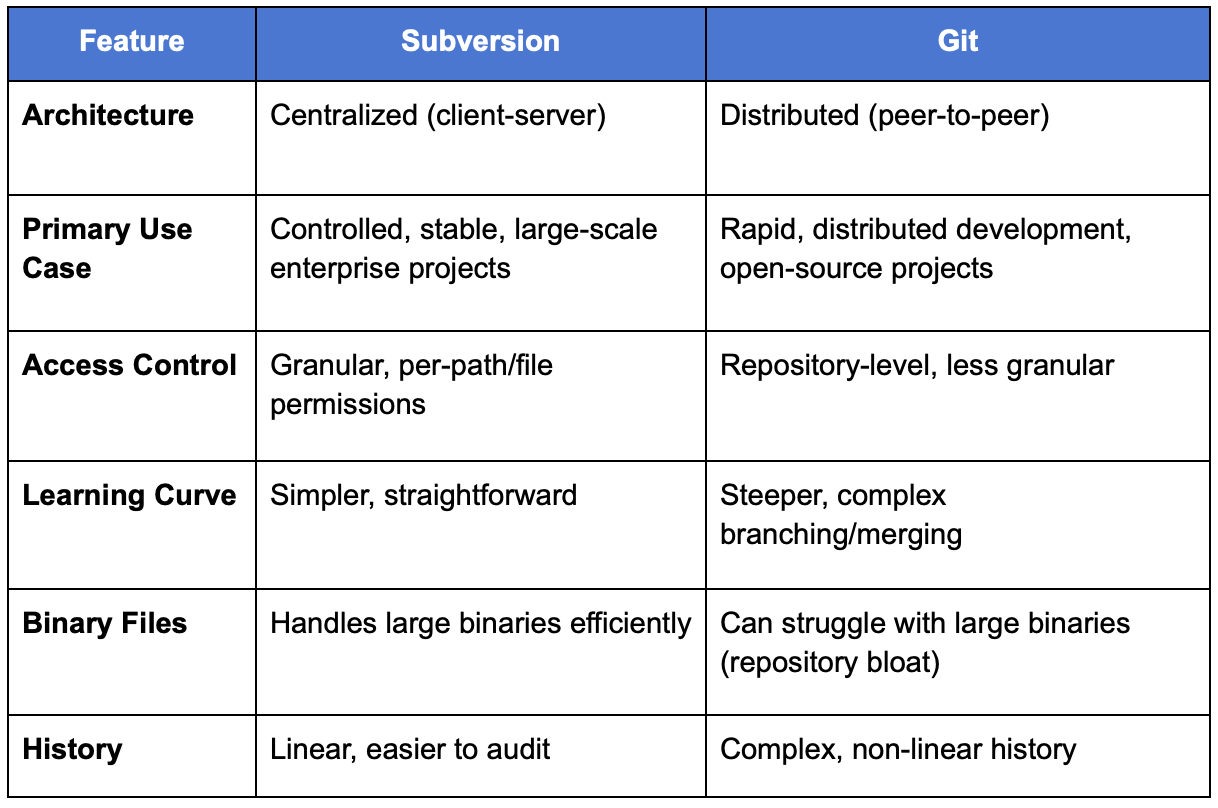
This table highlights why, for specific enterprise needs, svn vs. git comparisons often lean towards SVN when absolute control, simplicity in auditing, and handling of diverse file types are essential. While GitHub vs. Subversion is a common comparison for collaborative platforms, the underlying version control mechanisms differ significantly in their operational philosophy.
The Role of RhodeCode in Modern SVN Management
While the core strengths of SVN remain, modern enterprise requirements demand more than just basic subversion support. This is where platforms like RhodeCode become indispensable. RhodeCode transforms traditional svn development into a state-of-the-art experience by providing:
- Unified Source Code Management. RhodeCode offers a single platform to manage SVN, Git, and Mercurial repositories, allowing enterprises to maintain existing SVN investments while gradually integrating or migrating to other VCS technologies if needed. This flexibility is crucial for organizations with diverse development needs.
- Enhanced Security and Compliance. RhodeCode adds an extra layer of security, audit trails, and policy enforcement on top of SVN, meeting the most stringent enterprise compliance requirements. Its robust access control goes beyond native SVN, offering advanced authentication and authorization mechanisms.
- Code Review and Collaboration Tools. RhodeCode brings modern code review workflows, pull requests, and integrated discussion features to SVN repositories, fostering better collaboration and code quality without forcing a complete migration to a different version control system.
- Scalability and Performance. Designed for enterprise scale, RhodeCode ensures optimal performance for large SVN repositories, even with thousands of users and millions of files. It addresses common performance bottlenecks associated with traditional SVN servers.
By using RhodeCode, enterprises can leverage the stability and control of SVN while benefiting from modern development practices and tools, effectively future-proofing their subversion management.

Future-Proofing SVN: Why Continued Investment Makes Sense
For many organizations, the question isn't whether to abandon Subversion, but rather how to optimize and modernize its subversion usage. The investment in existing SVN infrastructure, processes, and developer expertise is substantial. Ripping and replacing a deeply embedded svn version control system can be incredibly costly, disruptive, and risky.
Instead, enterprises are finding that with platforms like RhodeCode, they can extend the life and enhance the capabilities of their Subversion deployments. This strategic approach allows them to:
- Maintain Operational Continuity. Avoid the significant downtime and learning curve associated with a full migration.
- Leverage Existing Knowledge. Continue to utilize the deep institutional knowledge and best practices built around SVN over many years.
- Gradually Adopt New Practices. Integrate modern tools and workflows (like advanced code review) without an abrupt shift in the underlying VCS.
- Benefit from Cost-Effectiveness. Often, optimizing an existing system is far more cost-effective than undertaking a complete overhaul.
Frequently Asked Questions
1. What does SVN stand for and what does it mean in practice?
SVN stands for Subversion. In practice, it refers to a centralized version control system that tracks all changes made to files and directories, allowing developers to collaborate and revert to previous versions of their code.
2. Is SVN still used by large companies?
Yes, many large enterprises, particularly in sectors like finance, government, and embedded systems development, continue to use SVN due to its stability, strong access control, and established processes.
3. What is the main difference between SVN and Git?
The primary difference lies in their architecture: SVN is centralized, meaning all operations go through a single server, while Git is distributed, allowing every developer to have a full copy of the repository and work offline. This affects aspects like branching, merging, and access control.
4. Can SVN handle large codebases and binary files?
Yes, SVN is well-suited for managing large codebases and handles binary files more efficiently in its centralized model than Git, especially when frequent changes to large binaries occur.
5. How can enterprises modernize their SVN environment?
Enterprises can modernize their SVN environment by integrating it with platforms like RhodeCode, which provide enhanced security, advanced code review tools, and a unified interface for managing multiple version control systems.
Conclusion: SVN's Enduring Value for Enterprises
The notion that Subversion is obsolete is a simplification that overlooks its critical role in numerous enterprise environments. For organizations prioritizing stability, granular control, robust auditing, and efficient management of large, often heterogeneous codebases, subversion source control remains an indispensable tool. With platforms like RhodeCode providing a modern overlay, enterprises can continue to leverage the strengths of SVN while embracing contemporary development practices. The question is not whether SVN uses will decline to zero, but how its enduring value will be optimized for the unique demands of enterprise development in 2026 and beyond.
Ready to enhance your enterprise Subversion control? Explore how RhodeCode can modernize your svn version control system and streamline your development workflows today.