AI can now write production code faster than many organizations can review it. That changes more than developer productivity. When an AI coding agent generates a function, fixes a bug, refactors a service, or prepares a pull request, the repository may still record a human developer as the author. What it often does not record is which AI agent produced the code, what prompt influenced the result, what context the model received, or whether the generated code passed the required human review.
For enterprise teams, that is a governance gap. AI-generated code governance is the set of policies, technical controls, review processes, and audit mechanisms used to determine how AI can contribute to a software project. The objective is not to prevent developers from using AI. It is to make AI-assisted software development traceable, reviewable, secure, and compatible with the same controls already applied to human contributions. As AI coding agents gain more autonomy, enterprises need to answer a new question:
“How do you keep the speed of AI without losing control of the code entering your repositories?”
Why AI-Generated Code Changes Software Governance
Traditional source code management is built around a relatively simple assumption: a person makes a change, Git or another version control system records it, and the organization can trace that change back to an account. AI coding breaks part of that assumption. A developer may ask an agent to implement an authentication flow. The agent can inspect multiple files, generate hundreds of lines, modify tests, and suggest a commit. The developer may then approve the result and push it.
The repository records the commit. But the commit alone may not explain how the code was created. This is the distinction between commit history and AI code provenance. Git can tell you who committed a change. Effective AI code governance should also help answer questions such as which agent generated it, what instructions influenced it, whether a human reviewed it, and which governance rules applied before it was merged. That matters for engineering teams, but also for security, legal, compliance, and risk teams.
RhodeCode has already explored this accountability gap in When the AI writes the code, who’s accountable?. As AI contributions become a normal part of software development, accountability needs to extend beyond the human identity attached to a commit.
What Is AI-Generated Code Governance?
AI-generated code governance defines how organizations allow, review, trace, and control code created with AI. It is one part of broader enterprise AI governance, but its scope is specifically software delivery. Instead of governing every AI model used by the company, it focuses on the path between an AI coding tool and the production codebase.
A practical governance model should establish:
- which AI coding agents and models developers may use, what repositories and data they may access, and what types of changes they may make;
- how AI-generated code attribution, review, testing, security scanning, and approval are handled before merge;
- what AI code audit trail and provenance information must be retained for security, compliance, incident investigation, and future maintenance.
The important point is that an AI coding policy should be enforceable where possible. Document saying “AI-generated code must be reviewed” is useful. A repository workflow that prevents applicable changes from being merged until the required review occurs is much stronger.
The Main AI-Generated Code Risks
The fundamental risks of AI-generated code are not completely different from the risks of human-written code. Both can contain security vulnerabilities, logic errors, poor architectural decisions, or problematic dependencies. The difference is scale and context.
An AI coding agent can generate and modify code much faster than a developer working manually. It may also operate with repository, terminal, issue tracker, or other tool access. A weak control that was manageable when developers wrote changes manually can become a larger problem when an agent can perform dozens of actions during one session.
Security and Quality
AI-generated code security cannot rely on the assumption that plausible code is correct code. Generated code may contain unsafe input handling, weak authentication logic, inappropriate dependencies, insecure defaults, or implementation choices that do not match an organization's architecture. This makes human review of AI-generated code important, particularly for high-risk changes. AI can assist with review as well. RhodeCode supports AI-assisted review workflows and has discussed the privacy implications in AI-Assisted Code Review Behind the Firewall. But automated analysis should complement the organization's approval process rather than make accountability disappear.
Excessive Agent Access
AI agent permissions deserve the same scrutiny as permissions assigned to users, CI/CD systems, and service accounts. An agent that only needs to analyze a repository should not automatically receive permission to modify protected branches. An agent working on one project should not gain unrestricted access to unrelated repositories. This makes AI agent access control a core component of secure AI-assisted development.
Missing Provenance
When a production incident occurs six months after code was merged, knowing that a developer committed the affected line may not be enough. Engineering teams may need to understand why that implementation was selected, whether it came from an AI agent, what prompt led to it, and whether the original output was changed during review. Without AI code provenance, much of that context disappears when the coding session ends.
A Governance Model for AI Contributions
AI governance in software development should not exist as a parallel process disconnected from the SDLC. It should extend controls enterprises already use for identity, source control, review, CI/CD, and auditing.
A useful model has five layers.
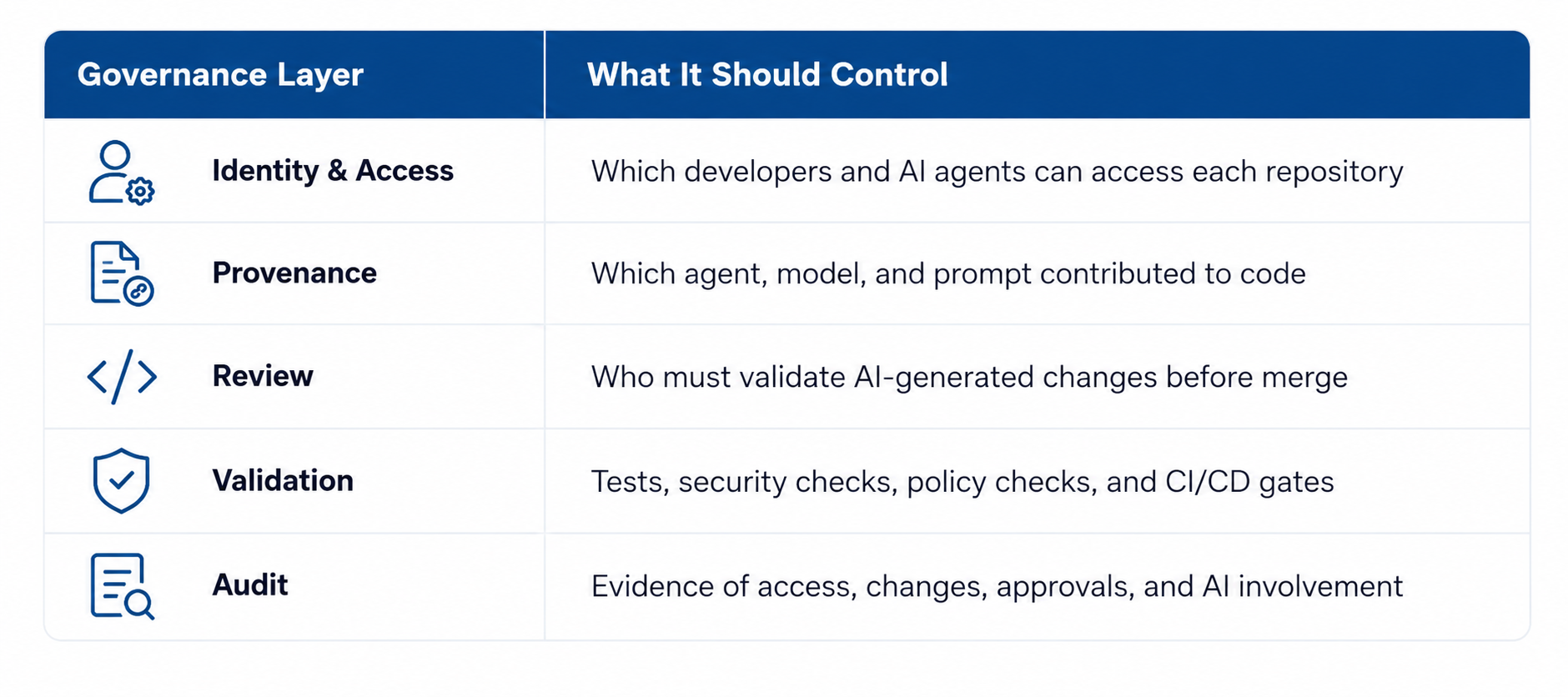
This approach makes AI governance in the SDLC an engineering control rather than a separate compliance exercise.
1. Control AI Agent Permissions
Start with least privilege. Treat an AI coding agent as another identity interacting with valuable engineering assets. Its access should reflect the task it needs to perform. Repository permissions, protected branches, scoped credentials, and authentication policies should determine what the agent or the developer operating it can actually change.
RhodeCode provides centralized permission management across Git, Mercurial, and Subversion repositories, including fine-grained repository access and enterprise authentication options.
For organizations managing large repository estates, this is particularly important. A broader explanation of the controls required at that scale is available in What to Look for in Enterprise Source Code Management Software.
2. Capture AI-Generated Code Attribution
Knowing who committed code and knowing how that code was produced are different things. This is where AI-generated code attribution becomes important. An effective provenance record can connect a source change to the AI agent, model, prompt, session, and subsequent human intervention involved in creating it. That information becomes useful well beyond compliance.
When a regression appears, developers can investigate not only the commit but the reasoning and context behind the generated code. When a security team investigates an incident, it can determine whether affected code originated from an AI workflow. Engineering leaders can also evaluate where AI is producing useful output and where it creates additional rework.
This is the problem Origin is designed to address. Origin records AI coding sessions and connects AI activity back to source code, including per-line AI attribution, prompt provenance, policy enforcement, usage visibility, and audit evidence. RhodeCode describes the combination as two complementary systems of record: RhodeCode governs the repository, while Origin records how AI produced the code.
3. Require Review Based on Risk
Not every AI-generated change requires the same level of scrutiny. Generating a unit test is not equivalent to changing authorization logic. Updating documentation is not equivalent to modifying payment processing.
AI-generated code review should therefore be risk-based. Organizations can define stricter review requirements for sensitive repositories, security-critical files, infrastructure configuration, authentication and authorization components, financial logic, or production deployment code.
RhodeCode Enterprise supports branch permissions and code review rules that can require changes to protected branches to go through review and can define who should review code based on organizational rules.
This provides a useful enforcement layer for AI coding governance: AI can accelerate implementation, while repository policy continues to control what reaches protected code.
4. Put Automated Validation Between Generation and Merge
Human review should not carry the entire burden. AI contributions should move through the same or stricter automated checks as other code. Depending on the project, that can include unit and integration tests, static analysis, dependency checks, secret detection, security scanning, license checks, and CI policy validation.
The key architectural principle is simple:
Generation should not equal acceptance.
AI coding agent can propose a change. The delivery pipeline decides whether that change satisfies engineering requirements. Authorized reviewer decides whether it should be accepted where human approval is required. This separation preserves the productivity benefits of AI without treating model output as trusted by default.
5. Build an Audit Trail That Includes AI
Traditional audit logs answer questions such as who accessed a repository, changed permissions, pushed code, or approved a review. AI introduces another dimension.
AI code audit trail should make it possible to connect repository activity with the AI context behind relevant changes. For organizations subject to internal controls or external audits, that creates stronger evidence than a commit record alone.
RhodeCode provides user access logging and enterprise-grade audit logs around source code management, while Origin extends traceability into AI authorship and prompt provenance.
Together, these layers can help organizations establish AI code accountability without replacing their existing source control workflows.
What an Enterprise AI Coding Policy Should Define
Useful AI coding policy should be short enough for engineering teams to follow and specific enough to enforce. It should define approved AI tools and deployment models, what source code or internal data can be sent to external models, repository and branch access rules, human review requirements, security and testing requirements, provenance retention, and exceptions for sensitive projects. The policy should also establish ownership.
Developers remain responsible for the code they submit. Reviewers remain responsible for approvals. Security teams define relevant controls. Platform or DevOps teams enforce those controls through repository and CI/CD infrastructure. AI does not need to become a new accountability gap between those roles.
Self-Hosted Source Control Matters More in AI-Assisted Development
AI-assisted software development creates another reason to examine where source code, prompts, and engineering context are processed. For some organizations, sending proprietary code to external systems is acceptable under established contracts and controls. For others particularly those operating in regulated, security-sensitive, or air-gapped environments it is not.
Self-hosted SCM gives organizations control over where their repository infrastructure operates. RhodeCode supports Git, Mercurial, and Subversion in a unified, self-managed environment and can operate within infrastructure controlled by the organization. For teams evaluating this deployment model, see the comparison of self-hosted source code management platforms.
Origin follows a similar model for AI provenance: RhodeCode states that it can be deployed self-hosted, on-premise, or air-gapped so prompts, diffs, and attribution data can remain within the organization's environment.
That creates an interesting architecture for organizations pursuing secure AI-assisted development: control the source code, control access to it, and preserve the provenance of the AI that helped create it.
RhodeCode and Origin: Two Layers of AI Code Governance
No single control solves AI-generated code governance. Repository governance and AI provenance solve different parts of the problem. RhodeCode manages the source code layer: repository access, permissions, authentication, branch controls, code review, integrations, and auditability across Git, Mercurial, and SVN.
Origin adds the AI context: which agent contributed code, which prompt produced it, what model was involved, and how AI activity maps back to the resulting source. The distinction matters. Repository can tell you what changed and who committed it. AI provenance can tell you how the change was generated and why. For enterprises adopting AI coding agents at scale, both are becoming part of the same governance problem.
AI Governance Should Enable AI, Not Block It
The goal of AI code governance is not to force developers back to manual coding. AI coding agents can reduce repetitive work, accelerate implementation, generate tests, explain unfamiliar code, and help teams move through large codebases faster. Organizations should be able to capture those gains.
But speed without traceability creates operational debt. Mature governance model allows AI to generate code while maintaining clear boundaries around access, review, validation, provenance, and accountability. Developers can use AI without turning the repository into a black box. Security teams gain evidence instead of assumptions. Engineering leaders can introduce AI across more teams without giving every agent unrestricted access to critical code.
The enterprises that handle this well will not necessarily be the ones that restrict AI the most. They will be the ones that make AI contributions as governable as every other change entering production. For organizations that need to keep source code under their own control, RhodeCode Enterprise provides the repository governance layer, while Origin extends that accountability to the AI agents writing the code.